Free Homeschool Field Trip Log: What Should You Track?
Try the 10-Minute Weekly Reset
Already tried a spreadsheet or an app that didn't stick? This free checklist is built for a week with more than one grade in it — the exact method from the HomeschoolPlanHub system, no card required.
or see every option, free to $49 — See Pricing
A homeschool field trip log answers one simple question: which outings, service hours, and activities happened this week or month. Not whether your child enjoyed them. Not the full learning outcome. Just: what, when, and for how many hours.
Without a proper field trip log, most parents remember the museum trip by September but forget the three nature walks that same month. Also, they lose track of whether a service project really was eight hours or just felt like eight hours. Worse still, come transcript time in high school, a parent has no documentation that the child completed required service hours or field trip hours their state might count toward instructional time.
This guide explains why tracking field trips and service hours matters and how to set up a system for compliance and portfolio building.
What does a homeschool field trip log record and why does it matter?
A homeschool field trip log is not a journal. It is not a travel diary. It is not a grade book for the activity. Instead, a homeschool field trip log records the name of the outing, the date, the subject area covered, and the hours spent in a clear, factual format.
Why tracking outings in a homeschool field trip log matters for compliance
The first reason for a homeschool field trip log is state compliance. Many states count field trips toward instructional hours. Also, some states require a minimum number of hours per year in a portfolio or as part of the attendance record. Others ask only that a parent be able to document what the child did, not how long it took.
A log kept all year answers that question in minutes. An auditor asking “what field trips did your high schooler attend” gets a factual answer instead of a shrug.
Service hours and extracurricular activities in the same log
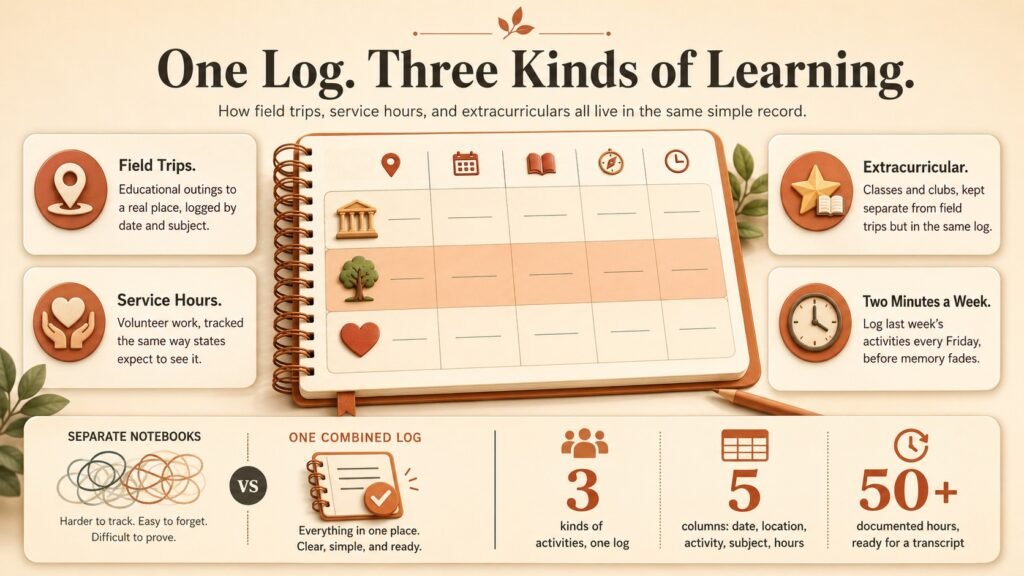
Service hours and extracurricular activities look similar in a log but serve different purposes. A service hour is volunteer work: cleaning up a park, helping at a local food bank, tutoring a younger child. By contrast, an extracurricular activity is a class or club: piano lessons, soccer practice, a robotics team, an art class at the community center.
Neither is exactly a field trip, which is typically an outing to a place rather than an activity at a fixed location. Even so, the same log handles all three because all three deserve documentation and all three might count toward a transcript, a service requirement, or a portfolio.
One family might use the same log entry to track a beach cleanup day that’s both a field trip (educational outing to a marine biology area) and service hours (volunteer cleanup). Another family logs piano lessons as extracurricular in the same line as actual field trip hours. All three fit naturally together in one tracking system.
What does a simple homeschool field trip log look like for a single child?
The smallest useful homeschool field trip log has five columns: Date, Location, Activity, Subject Area, and Hours.
For a child doing field trips throughout the year, a basic homeschool field trip log might look like this:
| Date | Location | Activity | Subject Area | Hours |
|---|---|---|---|---|
| Sept 3 | Natural History Museum | Dinosaur exhibit | Science, history | 2 |
| Sept 15 | Library | Community volunteer (shelving) | Service hours | 1 |
| Sept 22 | Park trail | Autumn leaf identification walk | Science, nature study | 1 hr 30 min |
| Oct 5 | Local animal shelter | Dog walking and care | Extracurricular, service | 2 |
| Oct 12 | Art gallery opening | Community art exhibition | Art, culture | 1 hr 30 min |
Overall, that’s what a basic homeschool field trip log looks like. When you fill it out as each activity happens, by December you know exactly which educational outings occurred and for how many hours total.
Why separating activity type matters in a homeschool field trip log
A field trip is not interchangeable with a service hour, and neither is the same as a piano lesson. By separating them by type in the Activity column, a parent gets clarity when reporting later. A state asking “how many field trip hours” can get a real number. Similarly, another state asking “service hours” can read down that specific column. A transcript listing “service learning” can pull those entries specifically.
Otherwise, a parent ends up with a list that says “activities: 47 hours” without any ability to separate which were educational outings, which were volunteer work, and which were class time.
What’s a worked example of tracking field trips, activities, and service hours for one year?
Here is what a real year of tracking looks like for a single high schooler. This homeschool field trip log shows field trips, service hours, and extracurricular activities all in one place.
| Date | Location | Activity | Subject Area | Hours | Notes |
|---|---|---|---|---|---|
| Sept 4 | Science center | Planetarium show | Science, astronomy | 1 hr 30 min | Supplements physics curriculum |
| Sept 18 | Local farm | Farm tour and harvest | Science, agriculture | 2 | Counts toward service hours |
| Oct 2 | Museum of art | Impressionist exhibit | Art history | 1 hr 30 min | Related to art history course |
| Oct 14 | Boys and Girls Club | Math tutoring volunteer | Service, math | 3 | Weekly commitment, total for month |
| Oct 25 | County courthouse | Legal system tour | Civics, social studies | 1 | Related to government course |
| Nov 8 | Forest preserve | Trail restoration | Service, environmental | 4 | One-day volunteer event |
| Nov 15 | Community theater | Shakespeare performance | Literature, drama | 2 | Live theater for English class |
| Dec 3 | Local food bank | Sorting and packing | Service | 2 | Holiday service project |
| Jan 22 | University campus | College visit and tour | Career/college prep | 2 | Attending with younger sibling |
| Feb 5 | Science museum | Hands-on physics lab | Science, physics | 1 hr 30 min | Aligns with course topics |
A homeschool field trip log like this tells the story of a year. Such a record shows that learning happened beyond the textbook. Beyond that, it demonstrates that a child completed service hours. Most importantly, the log proves that field trips connected to actual curriculum. A parent reviewing this before filling out a college application has real evidence to draw from.
How to handle field trips that cover multiple subjects in a homeschool field trip log
Some outings cover more than one subject naturally. A visit to a botanical garden might involve science (plant biology), art (landscape design), and history (garden history). Similarly, a historical site visit covers history, geography, and perhaps social studies.
Overall, the trick is not to overthink it. Write down the primary subject in the Subject Area column, then add secondary subjects separated by a comma if they genuinely apply. Keep the activity title in the Activity column specific enough that a future reader knows what the outing involved.
For example: “Botanical Garden Tour” under Activity, with “Science (botany), Art (design)” under Subject Area. Simple and clear.
When one activity counts as both field trip and service hours in your log
A volunteer cleanup day at a local park is both an outing (field trip) and service work. In a homeschool field trip log, record it once with both types marked. This is one advantage of combining field trips and service hours in a single log.
| Date | Location | Activity | Subject Area | Hours |
|---|---|---|---|---|
| Sept 24 | Riverside Park | Invasive plant removal | Field trip, service, science | 3 |
This approach works well. In fact, combining everything into a single log instead of keeping separate sheets for field trips, service, and activities is one of its real strengths.
How much detail is too much for a homeschool field trip log?
A field trip log doesn’t need a paragraph of reflection for every outing. Instead, keep it brief: “Notes: Learned about water cycles” works well. More detailed notes like “Class seemed unengaged until we got to the touch tanks, then energy picked up” help with planning next time. By contrast, a full journal entry is overkill and turns the log into a chore that stops getting filled out by October.
Still, some parents add a sixth column for “Learning Outcome” or “Curriculum Connection.” Examples: “Supports biology unit on ecosystems,” “Demonstrates service learning,” “College visit.” This is optional but useful if a parent is preparing a transcript or portfolio and wants to see at a glance how each outing connected to a larger goal.
At minimum, you need date, location, activity type, subject, and hours. Everything else is extra, which is fine if it doesn’t create friction.
How do you track field trip hours for compliance?
Different states count field trips and service hours differently. Before logging all year, check your specific state’s rules to understand which outings qualify.
States that count field trips toward instructional hours
Some states accept field trips as part of the total instructional hours required for the year. Others accept them but do not require them. A few do not count them at all. The Home School Legal Defense Association keeps a current, state-by-state summary of exactly which hours count, so check there before assuming your state treats field trips the same way as the one next door.
A log documenting that a child spent 40 hours on field trips and outings answers an auditor’s question immediately. The record proves that the learning took place, with dates and locations to back up the claim, the same way our homeschool attendance tracker guide covers proving instructional hours for the rest of the year.
States with explicit service hour requirements
A handful of states require a certain number of service hours per year for high schoolers. A documented log is the only way to prove this requirement was met. Otherwise, a parent ends up trying to reconstruct from memory in June.
Our homeschool requirements by state guide breaks down the specific field trip and service hour rules for all fifty states. Check yours before assuming what counts.
How to handle co-op field trips and classes
A field trip organized by a co-op still gets logged the same way. Similarly, an art class taken at a community center gets logged under Extracurricular Activity. A multi-family service project still counts as service hours for every student involved.
Log each student’s participation separately if it’s in a multi-child household, for the same reason we log each child’s attendance separately: because each student needs their own transcript record.
How do you use field trip logs for portfolios?
A portfolio is a collection of work samples showing what a student learned. Our homeschool portfolio examples guide covers what to include. A field trip log supports that portfolio by documenting the outings and experiences behind some of those samples.
For example, a student’s portfolio might include a watercolor painting from an art museum visit. The corresponding entry in the log for that museum day provides important context: the painting was not created at home in isolation, but inspired by an actual visit to professional work.
Similarly, a portfolio might include a reflection essay on a service project. The entry shows the hours and nature of that service, backed up by real documentation.
Overall, the log itself does not get pasted into the portfolio, but it provides the documentation that stands behind every entry.
Homeschool field trip log or curriculum tracker?
A curriculum tracker records what materials were used and how much was covered. By contrast, a field trip log records outings and activities.
These are separate systems. The curriculum tracker might say “Biology textbook, chapters 1-5.” Instead, the field trip log says “Natural History Museum, science, 2 hours.” They work together but they are not the same thing.
Some families keep both in the same planner to avoid flipping between notebooks. Others use separate systems. Neither is wrong as long as the two don’t get confused. A curriculum tracker that ends up mixing in field trip hours becomes unclear about what was taught formally and what was supplementary learning.
Our homeschool curriculum tracker guide covers tracking materials separately from tracking outings, so the two systems can work together without losing clarity.
Homeschool field trip log FAQ
Setting up your log
What if a field trip costs money? Should I track that? A field trip log tracks learning, not expenses, so mixing the two into one document usually just makes both harder to read. Skip the cost column and keep only the educational information, dates, locations, and what was learned. If tracking expenses matters for your budget, use a separate sheet dedicated to spending, since a state reviewer or evaluator has no interest in what an outing cost, only in what it taught. Even if tracking costs matters for your budget, keep it on a separate sheet from the learning log itself. To keep the expense sheet organized, create a simple table with columns for date, vendor, amount, and purpose, and link each entry to the corresponding field-trip date by using a consistent trip code, so you can quickly reconcile spending without cluttering the educational log, include a total row at the bottom and color-code rows by month to make quarterly reviews faster for budgeting purposes.
Can a field trip happen at home? Not in the traditional sense. A field trip is an outing to a place, which is the defining feature that separates it from regular schoolwork done at home. So, keep the definition specific: hands-on activities at home belong in your curriculum tracker instead, not in a log for outings, since blending the two makes both records less useful for showing what they’re each meant to show. Hands-on activities at home belong in your curriculum tracker instead, keeping the two records clearly separate. When you design a home-based outing, schedule a specific virtual museum or nature-reserve tour, note the exact URL, start-time, and duration in a dedicated ‘home field-trip’ worksheet, and attach a brief list of the interactive elements explored so that reviewers can see the structured, location-independent experience without mixing it into the traditional field-trip log, also record the learning objective you targeted and any follow-up activity you assign, which helps demonstrate intentional curriculum planning.
What if my child doesn’t enjoy a particular outing? Log it anyway. A field trip log is documentation, not a review, so the point is recording that learning happened, not rating how much your child enjoyed it. Whether the experience was memorable or boring does not change that it took place and that some learning occurred, even if the enthusiasm wasn’t there. Save the opinions for a journal or conversation; the log itself just needs the facts. Whether the experience was memorable or boring doesn’t change that some learning took place and should be logged. Even when enthusiasm is low, write down the precise state or Common Core standard addressed, the exact skill practiced, and any observable evidence such as a worksheet completed or a question answered, because evaluators look for concrete alignment rather than subjective feelings, and this level of detail lets you later reference the outing when planning remediation or enrichment, include the date and location field-trip code so you can cross-reference it with your curriculum map later.
Should I photograph field trips for documentation? Photographs provide helpful backup, but they are not required for the log itself. Instead, the record is the primary documentation, since a written entry with a date, location, and description is what most evaluators actually want to see. A photo backing it up is extra insurance, useful if a specific outing ever gets questioned, but not something you need to make time for on every single entry. A photo backing it up is extra insurance, useful if a specific outing is ever questioned. If you choose to take photos, save each image in a cloud folder named by year-month-day, use a filename that repeats the trip code and a brief descriptor (for example, 2023-04-15_T001_museum-exhibit.jpg), and then add that filename to the corresponding log row so the evaluator can locate the visual proof quickly without searching through unrelated images, also embed a short caption in the file’s metadata describing the activity, which can be exported later if a printed portfolio is required.
Tracking different types of activities
How do I log a multi-day trip? Log the whole trip as one entry with the total hours, rather than creating a separate line for each day of a multi-day outing. Generally, no need to break it into separate daily entries unless your state requires hour-by-hour documentation, and most states do not go into that level of detail. One clean entry with the trip’s total hours is both accurate and far easier to maintain than a fragmented daily breakdown. One clean entry with the trip’s total hours is far easier to maintain than a fragmented daily breakdown. When you enter the single record, list the trip’s start and end dates, total mileage, and a brief description of the primary learning objective so that reviewers can see both the time span and the educational purpose without needing separate daily notes, include the activity type, any guest speaker name, and attach a photo or worksheet reference as supporting evidence.
What if my child attends the same weekly class all year? You can log the total hours attended that month or quarter, not every single session, which keeps a recurring weekly activity from cluttering the log with dozens of nearly identical entries. For instance, “Weekly piano lesson, September through June, 32 hours” is cleaner than 32 separate lines and just as accurate for documentation purposes. Summarizing recurring activities this way is one of the easiest ways to keep a field trip log manageable over a full year. Summarizing a recurring activity this way keeps the log from filling up with dozens of nearly identical entries. To keep the log tidy, assign a short code such as “Pno” for piano and record the cumulative hours for each quarter, then note the curriculum standard or skill level addressed, which lets auditors quickly verify that the activity aligns with educational goals without scanning dozens of identical rows and can be cross-referenced in the portfolio.
Should I log neighborhood nature walks? Yes, if they are intentional learning activities, with a specific educational purpose behind them rather than just being outside. A daily walk around the block for exercise does not qualify as a field trip, since the intent there is physical activity, not instruction. However, a planned walk to observe seasonal changes in plants, or to identify birds, or to study geology should appear in your documentation, since the learning intent is what makes it loggable, not the distance walked. The learning intent is what makes an outing loggable, not the distance walked. Before the walk, write a one-sentence learning goal such as “identify three signs of seasonal change,” then after the outing record the specific observations, the species names you noted, and attach a quick sketch or photo, which provides concrete evidence that the activity met the educational intent required for logging and note the exact date and location site.
How do I handle multiple kids attending the same outing? Record each child separately on the log, since compliance and portfolio documentation are per-child, not per-family. Still, even though they attended the same museum visit, each child’s record should show their own participation, including any differences in what each one focused on or took away from the shared experience. For instance, an art museum visit might count as art history for an older child and visual exploration for a younger one. Create a column for each child’s name or ID, then in the shared row list the outing title once while entering each child’s individual hours, focus area, and a brief personal reflection or artifact reference, such as “collected dinosaur fossils” for one child and “sketched the solar system” for the other, which satisfies per-child documentation without duplicating the entire event description, also record the supervising adult’s name and any required consent form number to ensure compliance with record-keeping rules.
Compliance and transcripts
Does a field trip log satisfy state reporting requirements? In most cases, yes. An auditor asking about field trips gets a factual record with dates and hours, which is exactly the kind of documentation most state compliance reviews are looking for. Whether your specific state requires more information, like a written description of what was learned, is worth checking with your state department of education directly rather than assuming the bare minimum log covers every possible requirement. Whether your specific state requires more detail is worth checking with your state department of education directly. To stay safely within most state guidelines, add a teacher signature line, a one‑sentence learning objective for each trip, and a brief student reflection column, because auditors often look for evidence that the outing reinforced curriculum standards and that an adult verified the activity, which together turn a simple date‑hour list into a compliant record and also satisfy any supplemental documentation checklists the department may issue.
Can field trip hours count as part of a transcript? Field trip hours can be listed on a transcript under “Service Learning” or “Extracurricular Experience,” but they do not count as a course credit on their own. After all, a credit still requires formal instruction in that subject, with enough structured hours to meet a state or planning guideline. Field trips can support and enrich a course, but the course credit itself comes from the actual instructional hours, not the outings around it. A credit still requires formal instruction in that subject, so field trips support but don’t replace it. When you list trips, assign each a fractional experience credit, such as 0.2 or 0.5 credit, in the transcript’s Additional Learning section, attach a brief teacher endorsement describing the specific skill or content addressed, and ensure the total experience credits are tallied separately from academic credits so colleges can see the supplemental learning without confusing GPA calculations for admission decisions overall.
Should I mention field trips in a college application? Only if they connect directly to a course or to a learning interest the student is highlighting in their application. A casual outing does not belong on an application, since admissions readers are looking for meaningful connections, not a list of every place the family visited. By contrast, a field trip that led to a research project or sparked genuine interest does merit mention, especially if it ties into an essay or a specific area of academic interest. A casual outing without a clear academic connection generally doesn’t belong on an application. If you decide to include a trip, list it in the activities section with a concise description of the concrete outcome, such as presenting research findings from a museum visit that earned a top project grade or securing a mentorship after a science center tour, so the admissions committee sees a clear achievement rather than a vague outing for college.
Do I need to keep receipts or tickets from field trips? Keeping them is a smart practice, but not required for the log itself. Instead, save them with your portfolio as backup documentation, filed alongside other supporting materials rather than mixed into the log itself. Most auditors ask for the log, not the original tickets, so receipts function as a nice-to-have backup rather than something you need to hunt down for every single entry. Most auditors ask for the log itself, not the original tickets, so receipts are backup, not a requirement. A practical system is to scan each ticket or receipt immediately after the trip, name the PDF with the trip date and location, upload it to a dedicated cloud folder, and add the file name to a column in your field‑trip spreadsheet so you can quickly pull supporting proof when a reviewer asks for verification without rummaging through paper piles or a digital copy for each entry, ensuring traceability.
Working with multiple children
How do I handle field trip logs for multiple children at different ages? Each child gets their own log, or one shared log with a child column, whichever fits your family’s record-keeping style better. If multiple kids attended the same outing, still list them separately because their subject focus might differ. For example, an art museum visit might count as art history for an older child and visual exploration for a younger one, which is exactly the kind of distinction a combined entry would lose. Listing them separately preserves the detail that a combined entry would otherwise lose. To keep the logs organized, create a master spreadsheet that includes a separate column for each child’s name, age, and subject code, then use a consistent color‑highlight for each child’s rows so you can quickly filter or print individual records without manually copying entries, assign a short code like C1 or C2 for each child and add a one‑line note on any required accommodations, which speeds up audits.
What if siblings attend different classes at the same co-op? Record them separately in your documentation, even though the co-op day itself was shared. Also, each child’s record reflects their own participation, since one sibling’s class and hours at the co-op can differ meaningfully from another’s, even on the same day at the same location. Record them separately even though the co-op day itself was shared, since each child’s hours and subject focus can differ meaningfully. When siblings attend different co‑op classes, record each child’s attendance in a shared digital log but give them individual tab sections labeled with their names, include the exact start‑and end‑times for each class, note the instructor’s name and the specific curriculum unit covered, and attach a scanned copy of the co‑op’s daily sign‑in sheet to the child’s folder and confirm the total hours logged so that future auditors can verify that the overlapping day contained distinct instructional periods for each sibling without confusion.
Should I combine logs for siblings or keep them separate? For transcript purposes, separate logs are cleaner, since a transcript or portfolio review needs one child’s record isolated from a sibling’s. Still, one combined log works well for budget planning or a quick family overview, but gets messy when you need individual documentation later and have to untangle which entries belonged to which child after the fact. One combined log works for a quick family overview, but gets messy once individual documentation is needed for a specific child later. If you keep separate logs, store each child’s file in an individual binder that uses numbered index cards for every activity, then create a master summary sheet that tallies total hours per subject across the year, which lets you instantly generate a budget report while still preserving the detailed per‑child entries needed for college applications or state audits, and you can cross‑reference them with the state‑required quarterly compliance checklist for added assurance.
Beyond the log: creating a system that works
A homeschool field trip log works best as part of a larger system. Many families find that a single planner holding field trip logs, attendance records, curriculum tracking, and portfolio notes beats maintaining five separate systems.
Some parents photograph each outing or keep ticket stubs and brochures in a folder organized by year. These materials, paired with your homeschool field trip log, create a complete record. So, when a parent needs to defend the breadth of their child’s education to an auditor or build a college application transcript, having both the log and supporting materials tells the full story.
Other families include a reflection section. After each outing, the student writes one or two sentences about what they learned. As a result, this transforms the homeschool field trip log from a bare record into evidence of learning. A parent can then pull these reflections to include in a portfolio.
Handling special situations
What if a field trip takes all day or spans multiple days? Log it as a single entry with the total hours, treating a multi-day outing the same way you would a single-day one, just with a bigger hour total. No need to break it into separate daily entries unless your specific state requires hour-by-hour documentation. For example, a three-day museum workshop counts as one entry with the total twelve to fifteen hours, which is both accurate and far simpler to log than three separate daily lines. No need to break a multi-day outing into separate daily entries unless your specific state requires hour-by-hour detail. When a field trip spans a day or several days, record the event in your log with the exact start and end dates, total instructional hours, and a brief note on travel time and any off‑site assessment components, then attach the itinerary PDF as a document so the entry remains verifiable without breaking it into daily rows.
Can I count travel time as part of field trip hours? Most states do not count travel time as instructional time, treating the drive itself as logistics rather than learning. Instead, count only the hours spent at the destination or engaged in the learning activity itself. If your family travels four hours to reach a museum and spends four hours there, log four hours, not eight, since the travel time, however long, isn’t the part doing the educating. Count only the hours spent at the destination, since travel time itself isn’t the part doing the educating. You can record travel as a distinct logistical entry in your homeschool planner, noting departure and arrival times, mileage, any educational podcasts or audio lessons listened to during the drive, and brief observations of scenery that relate to the lesson, then file this entry with your other field-trip records for easy reference during any audit, including the date, location, and a one-sentence summary of what was covered.
What if my child misses part of the planned outing? Log the hours your child actually participated, not the hours the outing was originally scheduled to run. If a field trip was scheduled for three hours but your child only attended for ninety minutes due to illness or another reason, log one and a half hours. Honesty in documentation matters more than rounding up, since an inflated log that doesn’t match reality is a bigger risk than an accurate one that’s occasionally shorter than planned. Honesty in documentation matters more than rounding up to what was originally scheduled. If your child missed part of the outing, note the exact start and stop times of participation, describe the specific activities completed during that window, attach any worksheets, photos, or audio recordings that prove the learning occurred, and also record the reason for the absence and steps you plan to take to cover missed content, so the log reflects concrete evidence rather than just a duration estimate.
Should I log outings that weren’t planned in advance? Yes, if they involved intentional learning, even if the outing itself wasn’t planned in advance. An unexpected visit to a historical marker while driving, if the child learned about the history and you had a real conversation about it, counts as a field trip just as much as a planned museum trip would. Log it with the date, location, and what was learned, capturing the spontaneous learning moment before the details fade from memory. Log it with the date, location, and what was learned before the details fade from memory. When logging an impromptu learning outing, write the exact date, the specific location (including GPS coordinates if possible), a concise description of the topic discussed, and the duration of the conversation, then attach a quick photo or sketch that captures the scene to serve as visual proof for future reference, and you may also note any follow-up activities or resources you plan to explore to deepen the learning experience.
How does a homeschool field trip log connect to transcript building?
For high schoolers, every documented outing and service hour tells a story on a transcript. A college admissions officer reviewing a homeschool application expects to see evidence of real learning beyond textbooks. As a result, a well-maintained field trip log demonstrates that evidence directly.
When a high schooler has logged 50 hours of field trips across science museums, historical sites, and environmental work, that represents 50 hours of experiential learning. Similarly, when a transcript notes that a student completed 30 hours of community service, a field trip log backs up that claim with actual dates and descriptions. Overall, such documentation matters when a college is trying to understand whether a homeschool education was rigorous and real.
How do field trip logs work for different homeschool structures?
A field trip log works the same whether a family homeschools year-round or follows a traditional school calendar. Whether a child studies at home full-time or attends a hybrid co-op, the log captures identical information: what, when, and for how long.
A child in a homeschool co-op might attend class once a week. Log those co-op outings the same way as any other educational outing. Similarly, a child doing online school might attend virtual field trips. Those count too, logged with the date, the topic, and the hours spent. Overall, different approaches to homeschooling use field trip logs the same way: as documentation that learning happened in real places.
What are common problems with field trip logging and how do you solve them?
The homeschool field trip log starts strong and stops by March
The most common failure is enthusiasm that fades early in the year. A parent fills entries diligently through January, then stops. By April, the log sits empty while good outings go unrecorded.
Solution: keep entries simple and quick. A one-minute entry beats a five-minute entry that never happens. After a field trip, write one sentence in the Activity column and one in Subject Area. Overall, completion matters more than comprehensiveness. A log with basic entries beats a blank log entirely. The goal is documentation, not perfection.
Forgetting to log and the importance of a homeschool field trip log
Some parents skip logging during the year and try to reconstruct everything in July when filling out a transcript. Memory gets fuzzy, dates get confused, and hours become guesses. As a result, this scramble at year-end defeats the purpose of keeping a homeschool field trip log, which is to maintain an accurate record as things happen.
Solution: build logging into your weekly planner time. When you sit down Friday evening to plan the next week, also log the previous week’s activities. The trip is still fresh in your mind, and it takes two minutes instead of twenty. This weekly habit keeps records accurate and current. Instead of reconstructing later, logging as you go maintains integrity in your documentation.
Uncertainty about what counts
A parent isn’t sure whether a music lesson, a weekly soccer practice, or a day at a relative’s farm count as field trips in a homeschool field trip log.
Solution: Use common sense about your intention. If it involved intentional learning and happened outside the home in a planned educational way, log it. Casual activities like a daily walk to the park for exercise don’t count. By contrast, a planned nature walk to identify invasive species does. Similarly, a weekly music lesson counts as extracurricular activity. Finally, a casual visit to a relative doesn’t qualify, unless there’s intentional learning involved like studying farming practices.
Why we built a field trip and outing log into our homeschool planner
Everything above describes why field trip logging matters: compliance, portfolio building, transcript documentation, and evidence that learning happened beyond the textbook. Still, what it doesn’t describe is what it feels like to maintain that log throughout a year while juggling lesson planning, grading, and three other kids.
That’s why our homeschool planner includes both a Field Trip & Outing Log available as a standalone product for $4, and the complete tracker as part of the Family Bundle for $49, which also includes templates for reading logs, service hours, extracurricular activities, and attendance tracking all organized in one integrated system.
A field trip log by itself is just a table on a page. A field trip log built into a planner you use every week becomes a genuine habit and part of your routine. That consistent habit is what keeps your educational records honest through June instead of scrambling to reconstruct them in July when you need them most for applications or audits.
Try the 10-Minute Weekly Reset
Already tried a spreadsheet or an app that didn't stick? This free checklist is built for a week with more than one grade in it — the exact method from the HomeschoolPlanHub system, no card required.
or see every option, free to $49 — See Pricing