Homeschooling Multiple Grades: How Do You Manage It?
Try the 10-Minute Weekly Reset
Already tried a spreadsheet or an app that didn't stick? This free checklist is built for a week with more than one grade in it — the exact method from the HomeschoolPlanHub system, no card required.
or see every option, free to $49 — See Pricing
Most families searching for homeschooling multiple grades already have the kids. What they need is the system. How does one household run a real school day when a kindergartner, a fourth grader, and a ninth grader all need instruction on the same Tuesday morning? This guide covers homeschooling multiple grades the way it actually happens at the kitchen table.
Also, it covers the parts most guides skip. Records need to hold up across every grade level. A high schooler’s credits have to keep moving forward while a toddler naps down the hall. A curriculum budget shouldn’t double for every extra kid.
What does homeschooling multiple grades look like day to day?
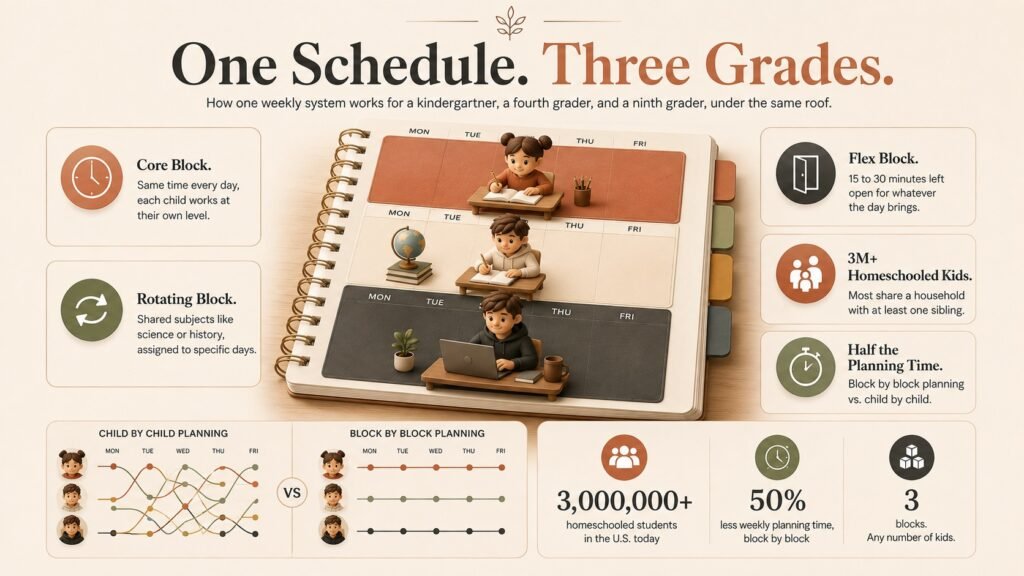
More than three million kids are homeschooled in the United States today, according to the National Home Education Research Institute. Most of them share a household with at least one sibling. In fact, homeschooling multiple grades is the normal case for this community, not the exception.
Most advice about homeschooling multiple grades describes a philosophy. Still, few guides show an actual clock. A real household needs both: a reason the system works, and a schedule that survives a rough Tuesday.
The block method behind homeschooling multiple grades
The most reliable way to run a mixed-age household is to plan by block, not by child. A core block covers the one or two subjects every kid does daily, usually math and language arts. Each child works at their own level, but in the same time slot.
Next, a rotating block covers subjects like science, history, or art. These don’t need daily attention, so they get assigned to specific days instead of every day. A flex block sits open on purpose, usually fifteen to thirty minutes with nothing scheduled. It absorbs whatever the day throws at the household: a slow morning, a doctor’s visit, a lesson that ran long.
This three-block structure is exactly what our own homeschool weekly planner is built around. Without a shock absorber built into the week, homeschooling multiple grades turns one late morning into a lost afternoon.
Why grouping by subject beats grouping by child
Planning child by child means answering the same kinds of questions two or three or four times over. Planning block by block means deciding the core block for everyone in a single pass. Then the rotating block, in one pass. Then flex, in one pass. Overall, the decisions stay individual. Only the order changes. Families who switch from child-by-child to block-by-block planning often cut their weekly planning time close to half. They stop bouncing between “what does my second grader need” and “what does my ninth grader need” every few minutes.
What does a real weekly schedule for homeschooling multiple grades look like?
Here is what a full week looks like once the block method gets applied to three kids at three different levels, not just described in the abstract.
Worked example: kindergartner, fourth grader, ninth grader
The core block runs first, same time every day. Twenty minutes of phonics and counting come first for the kindergartner, one on one with a parent. Math and grammar take about forty-five minutes for the fourth grader, working independently with a check-in partway through. Algebra and composition run for an hour with the ninth grader, mostly solo, since high school work needs to be independent by this stage anyway.
Even so, all three blocks can start at the same clock time. A parent stays hands-on with only one child at once, while the other two work through material they can mostly handle alone.
Next, the rotating block takes over. Science lands on Monday and Wednesday. The two younger kids work at the same table, while the ninth grader handles a separate lab-based unit nearby. History lands on Tuesday and Thursday, read aloud as a group. The older two write a short response afterward, and the youngest just listens and asks questions. Finally, Friday stays open for whichever rotating subject needs a second pass that week.
| Time block | Kindergartner | Fourth grader | Ninth grader |
|---|---|---|---|
| Core (morning) | Phonics and counting, guided | Math and grammar, independent | Algebra and composition, independent |
| Rotating (Mon/Wed) | Science with sibling | Science with sibling | Separate lab unit |
| Rotating (Tue/Thu) | History read-aloud, listening | History read-aloud, short response | History read-aloud, short response |
| Flex (daily) | Open | Open | Open |
A second worked example: two kids, two grades apart
Not every household spans a huge age range. A second grader and a fourth grader, only two grades apart, still benefit from the same block structure, just with less distance between their levels. The core block still runs separately for math, since even a two-grade gap in math usually means different concepts entirely. In practice, language arts sometimes overlaps enough that a shared spelling list or grammar lesson works for both, with the fourth grader tackling a harder version of the same rule.
For this pairing, the rotating block does more of the heavy lifting. Science, history, and art run together nearly every time, since the gap is small enough that one lesson genuinely reaches both kids without watering it down for either. Even so, the flex block still matters just as much here as it does with a wider age range. After all, a two-grade gap doesn’t mean fewer surprises during the week, just different ones.
Where the flex block earns its keep
A week with no flex block is a week with no room for anything to go sideways. Something always does. Homeschooling multiple grades multiplies the number of things that can knock a day off course. Three kids means three moods, three energy levels, three chances for a lesson to run long.
In practice, protect the core block first when the week slips. Instead, let the rotating block absorb the loss, since it can wait until next week’s rotation without real damage. Overall, that single rule resolves most “the day fell apart” moments before they turn into a real problem.
How do you homeschool multiple grades without losing one-on-one time?
A common worry about homeschooling multiple grades is that no single kid gets a parent’s full attention anymore. In fact, the block system protects one-on-one time instead of erasing it. It just delivers that time in shorter, more frequent doses instead of one long session.
Rotating who gets full attention first
Whoever needs the most direct teaching that day goes first in the core block, while the others start on review or independent work. Rotate that order through the week so the same kid isn’t always waiting. For example, a kindergartner who needs help every single day still gets it first most mornings, since early reading and math genuinely can’t wait behind an older sibling’s independent work.
Letting older kids teach younger ones
An older child explaining a concept to a younger one is a legitimate teaching method, not just a shortcut for a busy parent. Explaining a fraction out loud to a little sibling forces the older kid to understand it instead of just recalling it. Keep these sessions short, ten minutes at most, and pick topics the older child already knows solidly. Overall, this works especially well during the flex block, when nothing else is competing for the room.
How do you homeschool multiple grades when one kid is in high school?
Nearly every guide to homeschooling multiple grades assumes every child is under twelve. Plenty of real households have a toddler, a middle schooler, and a high schooler under one roof at once. The high schooler’s needs change everything about the schedule.
Keeping credits and transcripts moving while teaching littles
High school work has to be tracked as it happens, not reconstructed later from memory. Course titles, credit hours, and grades need a running record from the first week of ninth grade. Colleges and financial aid offices expect a transcript that reads like an ongoing document, not a project assembled the week before applications are due. Our homeschool transcript template guide walks through the exact format colleges expect, including how a subject taken independently, while a parent teaches a younger sibling, still counts toward a full credit.
Here’s the upside of homeschooling multiple grades with a teenager in the mix: the teenager usually needs far less direct instruction time than the younger kids do. As a result, a parent’s morning opens up for exactly the ages that need hands-on help most.
How much direct time a high schooler still needs
Independent does not mean unsupervised. A short daily check-in, even five or ten minutes, catches a stuck assignment before it becomes a missed week. Instead, weekly subject reviews work better than daily hovering for a teenager who manages their own workload well. Aim for a light touch that still catches problems early. Otherwise, a fully hands-off approach only surfaces trouble at the end of a grading period, when it’s harder to fix.
How does state compliance work when homeschooling multiple grades?
Legal requirements do not pause just because a household spans several grade levels. In fact, a few states apply different rules by grade or age, so a family with a wide age range has to track more of them than a single-grade household would.
When requirements differ by grade level
Some states only require testing or a portfolio review once a child reaches a certain age. A household homeschooling multiple grades might have one kid who needs an annual evaluation and two who don’t yet. On top of that, a few states require a notice of intent per child, not per family. Adding a new kindergartner to an already-homeschooling household can mean a fresh filing, even though nothing else changed.
The Home School Legal Defense Association keeps a current, state-by-state summary of exactly which rules apply at which age. It’s worth checking every time a child crosses into a new requirement bracket. Our own homeschool requirements by state guide breaks down the specific rule for all fifty states, including where those rules shift by grade.
One record system, several kids
Attendance, portfolio, and transcript tracking work best living in one shared system, not three separate habits per kid. A single planner that holds records for every child in the household is what keeps things intact by June. Otherwise, the alternative is records scattered across whatever notebook or app seemed convenient back in September.
Our homeschool attendance tracker guide covers what most states expect to see. Also, it covers how to log it without turning it into a nightly chore for every kid separately. Even a household with just two kids benefits from this: five minutes logging one shared page beats ten minutes split across two separate notebooks, every single week of the year.
How do you homeschool multiple grades with a toddler or preschooler underfoot?
No lesson plan makes a toddler sit still for long. And no schedule survives contact with one that ignores that fact.
Busy boxes and independent work stations
A busy box is a small container of toys or activities reserved only for homeschool hours. Over time, a toddler starts to associate it with a specific block of time, rather than boredom. Rotate the contents every week or two to keep them interesting. Set the box up right next to wherever the core block happens, so the toddler stays close without constant redirection. Overall, this buys the parent the ten or fifteen focused minutes that block needs.
Protecting the core block when a little one melts down
A toddler meltdown during the core block is one of the most common reasons homeschooling multiple grades feels impossible some mornings. The fix is rarely a better toddler strategy. Instead, it’s usually a shorter core block for that one day, with the missed material picked up the next morning. After all, forcing a lesson through a meltdown rarely produces real learning for anyone in the room.
How do you homeschool multiple grades with a child who has an IEP or learning difference?
Pacing matters most when a gifted child and a child with a learning difference share the same household. Different content alone isn’t enough.
Adjusting the core block without abandoning it
The core block still applies, but the time allotted and the format can flex per child without breaking the overall structure. For example, a child who needs extra processing time gets a longer core block slot. Similarly, a child who works best standing up or moving gets the same material delivered differently.
Many states allow this flexibility by design, since a homeschool plan legally belongs to one family, not one standardized classroom. Even so, an existing IEP or 504 plan from public school does not transfer automatically into a homeschool setting. Instead, check with the state department of education directly. Some states also offer homeschool-specific special education support through the local district, though availability varies enough that it’s worth confirming directly.
How do you homeschool multiple grades as a working or single parent?
Almost every guide to homeschooling multiple grades assumes a parent is home and available all day. In reality, plenty of real households run on one income earner homeschooling solo, or on a parent working from home in between blocks, and the system still has to hold together.
Which blocks need a parent physically present
The core block is the one that genuinely needs a parent in the room, since it covers the subjects that need real teaching. By contrast, the rotating and flex blocks can often run with a parent nearby but not fully hands-on, especially once kids are old enough to start independent or paired work.
Structure a workday around the core block, rather than trying to squeeze homeschooling into whatever gaps a job leaves open. This protects the one part of the day that can’t just happen on its own. Our homeschooling while working full-time guide covers this in more depth, including how to build a schedule around a job that doesn’t have flexible hours.
What a single parent can realistically cut
A single parent homeschooling multiple grades rarely has the bandwidth for every enrichment extra a two-parent household might add. A few cuts reduce the daily load without touching the core subjects that matter most. For instance, trim elective rotations down to one or two. Also, lean harder on shared read-alouds instead of separate lessons per kid. Finally, treat co-op days as a built-in break, not one more thing to plan around.
What combined subjects work across grade levels?
Not every subject needs separate instruction for every kid. Knowing which ones can share a lesson is most of what makes homeschooling multiple grades manageable instead of exhausting.
Read-alouds, history, and science together
History and science both work well taught as a group, with the same topic pitched at multiple depths. For example, a younger sibling listens to the same read-aloud an older one takes written notes on, absorbing what they can at their own level. An older child goes deeper on the same topic a younger one covers more simply, often at the same table.
Nature study, art, and music combine easily too, since none of them depend on sequential mastery the way math does. Many families run these combined subjects through a short morning basket time before the core block even starts, so the whole household stays together for the parts of the day that work best shared.
Subjects that can never be combined
Math and reading instruction almost always need to happen separately by level. Both build in a strict sequence, and a shortcut compounds into a real gap fast. Similarly, spelling and grammar usually fall into the same category once a child moves past the earliest years. Trying to combine these anyway is one of the most common reasons a family gives up on homeschooling multiple grades together. As a result, they revert to teaching each kid in full isolation, which then eats far more of the day than it needs to.
Co-ops, classes, and field trips with a mixed-age group
A homeschool co-op groups kids from several families by subject or interest instead of strict grade level, which mirrors the same logic as combining subjects at home. Similarly, a single field trip or nature outing usually works for a wide age range with almost no extra planning. Younger kids absorb what they can, while older ones dig into more detail on their own.
Likewise, group classes for a foreign language, art, or a science lab often split loosely by skill rather than age. A strong younger reader and an average older one can land in the same section without either feeling out of place. Overall, treat these outside activities as part of the week’s rotating block, not as an extra squeezed in after everything else is already done. Each child also needs at least one peer friendship of their own outside the house, not only shared family activities.
How do you adjust your homeschooling multiple grades plan as kids move up?
A system built for homeschooling multiple grades this year won’t necessarily fit the same way next year. After all, grade levels shift every September, so the block assignments should shift with them.
Re-sorting the core block every year
A kid who needed twenty minutes of guided phonics at the start of the year might read independently by spring. So, revisit each child’s core block length and format at the start of every year, not just once when the system first gets built. Otherwise, a block that no longer matches a kid’s actual level either wastes their time or leaves them behind.
When two kids finally land in the same block
Every so often, two kids land close enough in level to share a core block for a subject, at least for a season. For instance, a second grader catching up to a struggling fourth grader in reading can sometimes join the same guided session for a while. Even so, treat this as temporary, and keep checking that it still fits. Typically, the gap reopens within a year or two as the older child moves ahead again.
How do you budget curriculum when homeschooling multiple grades?
Curriculum costs do not have to multiply by the number of kids in the house, even though it can feel that way in September.
What to buy once vs. per child
Consumable workbooks, anything with fill-in answers, generally need one copy per child. Teacher’s guides, literature sets, science kits, and most read-aloud material can be shared across every kid using them that year. Buying used from a local homeschool group or a curriculum swap page cuts this cost further, especially for materials that only get used lightly before a family moves on.
Also, a library card covers a surprising share of the read-aloud and living-book list for free. This matters most in the early years, before a family settles on which subjects are worth paying full price for.
A simple cost example across three kids
A family running three kids through a shared history and science curriculum, buying only the consumable workbooks new per child, typically spends far less than three separate full curriculum packages would cost. The core subjects, math and language arts, are usually where the real per-child cost lives. Those need individual, level-appropriate materials. Budget around that split: shared where possible, individual only where it has to be.
As a result, that keeps the yearly cost of homeschooling multiple grades from scaling in a straight line with the number of kids at the table. Also, tracking what got used, versus what sat on a shelf untouched, over one full year makes next year’s budget far more accurate than guessing fresh each August.
What are the most common homeschooling multiple grades mistakes?
A few mistakes show up again and again in households just starting to juggle more than one grade level at once.
Planning child by child instead of block by block
Starting the week by finishing one kid’s full schedule before moving to the next means re-deciding the same kinds of questions repeatedly. It takes roughly twice as long for barely any real benefit. Instead, block-by-block planning solves this directly. In fact, it’s the single biggest time-saver available to anyone homeschooling multiple grades at once.
Copying a school schedule instead of building a household rhythm
A traditional school day includes transitions, group management, and time built for a room of twenty-five kids. None of that applies to a household of three or four. In fact, homeschooling rarely needs six hours to cover what a school day covers in the same span. Trying to run that many hours across multiple grade levels usually burns out the parent long before it helps any of the kids involved.
Ignoring the age gap until it causes a real problem
Some families plan as if every kid will stay close in age and ability forever. In reality, gaps widen every year, not just in academic level but in attention span and independence. Revisit the block assignments every few months, rather than setting them once in August and hoping they still fit by spring. A ten-minute check-in on a Sunday catches most of these mismatches before they turn into a frustrating week.
What are signs your homeschooling multiple grades system needs to change?
A system that worked in October can stop working by January, and that’s normal, not a sign of failure. Kids grow, workloads shift, and a plan built in August rarely fits perfectly by the middle of the year. So, watch for a few warning signs in particular.
When the flex block never has time to breathe
If the flex block gets scheduled over every single week without exception, the core or rotating blocks are probably running long. That’s a sizing problem, not a discipline problem. Instead, shave five or ten minutes off the block that keeps eating into flex, rather than cutting flex out of the day entirely.
When one kid always finishes first and waits
A kid who consistently finishes the core block early and sits waiting for a parent’s attention is a sign that child’s block needs more material, not less time. The opposite problem, a kid who never finishes on time, usually means the block is sized for a grade level the kid has already moved past or hasn’t reached yet. Either way, the fix lives in the block length or content, not in pushing through the same setup for another month and hoping it resolves itself.
Homeschooling multiple grades FAQ
Scheduling questions
How many hours a day should homeschooling multiple grades take? Most families find that two to four focused hours across the whole household covers what a full school day covers, since one-on-one and small-group instruction skips the transitions and whole-class management that eat up a large share of a traditional school day. Even so, the number rises somewhat with more kids at more levels, since more grade levels means more separate core-subject instruction to fit in. It rarely doubles, though, since combined subjects and independent work absorb much of the added complexity. Combined subjects and independent work absorb much of the added complexity that comes with more grade levels. To keep the two-to-four-hour window realistic, schedule a 15-minute transition between each grade’s core subject, use a visual timer for each block, and let older children lead the younger ones in shared reading or science experiments, which compresses instruction time while reinforcing concepts and also build confidence in leadership for both.
Should every kid be on the exact same schedule? No. Each child’s core block can sit at a different time if that fits the household better, staggered around naps, other siblings’ independent work, or whatever rhythm actually works for that family. The one rule: a parent shouldn’t be needed hands-on with two kids at the same minute, since that’s the scheduling conflict that actually causes problems, not whether everyone starts school at the same clock time. The one rule is that a parent shouldn’t be needed hands-on with two kids at the exact same minute. A practical way to avoid overlap is to give each child a separate colored index card for their core block on a family wall calendar, write the exact start and end times in bold, and place a reminder sticker on the parent’s own schedule so they can instantly see when one child’s lesson ends and the next begins, preventing the need to multitask today.
What if the week falls apart by Wednesday? Protect the core block first, since that’s the instruction most likely to need daily consistency to stick. Let the rotating block absorb the disruption instead, shifting or skipping a subject rather than forcing the whole week back on track at once through a stressful catch-up session. A multi-grade household falling apart mid-week is even more common than a single-child one, simply because there are more moving pieces that can go sideways at once. A multi-grade household falling apart mid-week is common simply because there are more moving pieces that can go sideways at once. Keep a small portable notebook labeled ‘mid-week rescue’ where each child can jot the key points missed on Wednesday, and schedule a 10-minute review on Thursday morning before the next core block, allowing the family to patch gaps without extending the overall day, it gives parents a quick reference and keeps daily learning flow steady throughout.
Curriculum and combined-subject questions
Which subjects work best combined across grade levels? History, science, art, music, and read-alouds combine well, since a family can explore the same topic or story together with each child engaging at their own level. None of them depend on strict sequential mastery the way math does. By contrast, math and language arts almost always need separate, level-appropriate instruction, since skipping a step in either subject creates real gaps that catch up with a student later. Math and language arts almost always need separate, level-appropriate instruction since they build sequentially. When planning a combined history or science unit, create a master timeline on a large sheet of paper and assign each grade a colored sticky note to add age-appropriate facts, then let the older child read the primary source aloud while the younger one draws a related illustration, which reinforces comprehension and gives both a concrete contribution to the shared project without requiring separate lesson plans for learning.
Do I need a different curriculum for every child? Not for every subject. Shared read-alouds, history spines, and science kits work across a wide age range, letting one purchase or one lesson cover multiple kids at once. Still, core subjects usually do need individual materials matched to each child’s level, since math and reading skills build sequentially in a way that doesn’t flex the same way a shared history topic does. Core subjects usually do need individual materials matched to each child’s level, even when other subjects are shared. To keep the math portion individualized, you can use a diagnostic quiz at the start of each term to place each child on a leveled worksheet set or adaptive app, then let the older sibling work ahead while the younger follows the same curriculum scaffold, and simply record each child’s scores in a shared spreadsheet that flags when a new level is reached for future reference and for parent review.
Is a unit study the only way to combine subjects across grades? No, though it’s a popular option among multi-grade families specifically because it’s built around exactly this kind of combining. A shared read-aloud or a single science topic taught at multiple depths achieves much of the same benefit without requiring a full curriculum overhaul. Neither requires committing to a full unit-study curriculum, so families can borrow the combining principle without adopting the entire approach. A shared read-aloud achieves much of the same benefit without committing to a full unit-study curriculum. You can also schedule a weekly interdisciplinary project where the older child researches the scientific principle while the younger records observations, then combine both contributions into a single presentation that satisfies the science standards for both grades and simultaneously meets language arts expectations for research and communication, include a rubric with grade‑specific objectives, assign each child a role matching their skill level, and use a free online template to log progress.
Records and compliance questions
Does every child need a separate attendance log? Most states track attendance per child, so yes, each child needs their own dedicated attendance record even in a household running on a shared schedule. Even so, a shared household planner can still hold every child’s log in one place instead of several separate systems, as long as each child’s entries stay clearly separated by name or by a dedicated section. A shared household planner can still hold every child’s log in one place instead of several separate systems. A practical trick is to create a master attendance table in a spreadsheet where each column represents a child, each row a date, and you simply tick the appropriate boxes, then set up conditional formatting that highlights any missed days in red so you can instantly see each child’s compliance without flipping through separate pages, add a note column for reasons, then export the sheet monthly for filing with homeschool records.
Do state requirements change once a child hits a certain grade? In some states, yes. Testing or portfolio review requirements sometimes start at a specific age or grade, often tied to entering a certain grade band rather than applying uniformly to every homeschooled child regardless of age. As a result, a household homeschooling multiple grades may have one child under a different rule than a sibling, which means checking your state’s requirements per child rather than assuming one blanket rule covers the whole family. A household homeschooling multiple grades may have one child under a different rule than a sibling because of this. Keep a digital folder for each child that includes the specific age‑based testing forms, portfolio checklists, and any exemption paperwork, and set a calendar reminder to review the folder at the start of each school year so you never miss a deadline that applies only to the older sibling, while the younger child only requires attendance logs daily.
Should I keep separate portfolios for each kid? Yes. A portfolio reflects one child’s actual work, so even a shared activity needs to be documented separately for each child. Even siblings working through the same read-aloud or science unit still need their own separate folder of samples, since what one child produced or understood from that shared activity can look quite different from a sibling’s version of the same experience. Even siblings working through the same read-aloud still need their own separate folder of samples. To keep the folders organized, assign each child a dedicated binder with their name on the spine, use color-coded tabs for subjects, and after each activity place a one-sentence reflection from the child on the inside cover, then scan the most important pieces into a cloud folder labeled by date and project so you can quickly retrieve samples for report cards, assessments, or college applications throughout the school year and keep them updated.
Age-specific questions
How do I handle a big age gap, like a toddler and a teenager? The teenager usually needs far less direct instruction time, since older students can work more independently through their coursework, leaving more of the parent’s attention for the toddler and any middle years kids who need more hands-on help. In practice, independent work for the oldest and a busy box or simple activity for the youngest cover most of the gap, freeing up focused one-on-one time for whichever child in the middle actually needs it most. Independent work for the oldest and a busy box for the youngest cover most of the gap in practice. Create a weekly visual schedule that blocks two-hour independent study periods for the teen, a 30-minute focused lesson for the toddler, and a flexible 45-minute slot in the middle for any child who needs extra help, then use a timer and a checklist so each family member knows exactly when their turn for attention arrives today.
Can a gifted child and one with a learning difference share a curriculum? Sometimes, for combined subjects like history or science taught at multiple depths from the same material, where both kids can engage with the same topic even if their output looks different. Core subjects almost always need separate pacing suited to each child’s actual needs, since a gifted child and a child with a learning difference typically need meaningfully different instruction speed and support in math or reading regardless of how the combined subjects are handled. Core subjects almost always need separate pacing suited to each child’s actual needs regardless of the combined subjects. Design a single project outline that lists core concepts, then give each child a customized worksheet that layers difficulty by adding optional challenge questions for the gifted learner while providing scaffolded prompts and graphic organizers for the child with the learning difference, allowing both to work side by side yet produce work at their appropriate level effectively.
At what age can a kid start working mostly independently? It varies by child more than by age, so treating a specific grade as a hard cutoff for independence usually doesn’t match reality. Many families see a real shift somewhere around fourth or fifth grade, once reading fluency supports working from written instructions without constant help, though some kids reach that point earlier and others need more support well into middle school. Many families see a real shift once reading fluency supports working from written instructions without constant help. Start by introducing a simple daily checklist that lists each subject, the page numbers or assignment titles, and a self-rating column where the child marks confidence after completing a task, then pair that list with a timer set for short work bursts and a brief end-of-day reflection journal, so the student learns to monitor progress, adjust pacing, and take ownership of learning without constant parental prompts and celebrate small successes daily.
Co-op and outside activity questions
Do co-ops usually group kids by grade or by something else? Most group by subject, skill level, or rough age band instead of exact grade, which fits a mixed-age household better than a strict grade cutoff would. This means a multi-grade family often doesn’t need to hunt for a co-op that perfectly matches every child’s exact grade level, since most co-ops are already built around more flexible groupings than a traditional school classroom uses. This fits a mixed-age household better than a strict grade cutoff would. To make scheduling easier, many co‑ops let parents submit a brief skill‑inventory sheet for each child and then use those data to place kids into interest‑based pods that meet at staggered times, so a family with a kindergartener and a fifth‑grader can attend the same weekly session while still receiving age‑appropriate activities, and the coordinator can adjust the pod composition each term without requiring the family to find a new group for the upcoming semester again.
Can one field trip really work for a big age gap? Yes, in most cases. A younger child takes in the general experience while an older one engages with more of the detail, so one outing covers both without extra planning or a need to split the family across two separate trips. Bringing an age-appropriate question or two for each child to focus on during the visit turns a single shared trip into a documented learning entry for both, even though they’ll take away different things from it. A younger child takes in the general experience while an older one engages with more of the detail. A tip is to give each child a notebook before the trip, ask the younger one to sketch one thing they notice and the older one to write a summary of a related concept, then after the visit compare notes so the family creates a combined journal entry that captures both perspectives without extra outings.
Why we built a planner for homeschooling multiple grades
Everything above (the block system, the shared records, the budget approach) only works if it lives somewhere a family opens every week. That’s why our homeschool planner was built around that exact problem. It gives every household one weekly layout with core, rotating, and flex blocks that scale from one kid to several.
In addition, state-aware record pages travel with every child in the house. Grade-band templates mean a kindergartner’s page and a ninth grader’s page live in the same system, not two different ones. Overall, homeschooling multiple grades well is less about finding one more clever trick. It’s about running one system that doesn’t fall apart the day a plan changes, which is most days in a house with more than one kid in it. than one kid in it.
Try the 10-Minute Weekly Reset
Already tried a spreadsheet or an app that didn't stick? This free checklist is built for a week with more than one grade in it — the exact method from the HomeschoolPlanHub system, no card required.
or see every option, free to $49 — See Pricing