Homeschool Burnout: How Do You Prevent It?

Try the 10-Minute Weekly Reset
Already tried a spreadsheet or an app that didn't stick? This free checklist is built for a week with more than one grade in it — the exact method from the HomeschoolPlanHub system, no card required.
or see every option, free to $49 — See Pricing
Homeschool burnout is not a personal failure. It is not a sign that you lack willpower or that your family is not cut out for homeschooling. Homeschool burnout happens when the structure of how you plan and teach does not match the reality of what your family needs to sustain the work.
For many parents, the burning-out moment arrives on Sunday night when the week ahead has no shape. Or it appears in March when the curriculum choice that seemed perfect in July is no longer working. Or it builds quietly over months of tracking attendance by hand, managing five different systems for five different children, and wondering why nothing feels organized even though the planning happens constantly.
The solution is not more discipline. It is better systems.
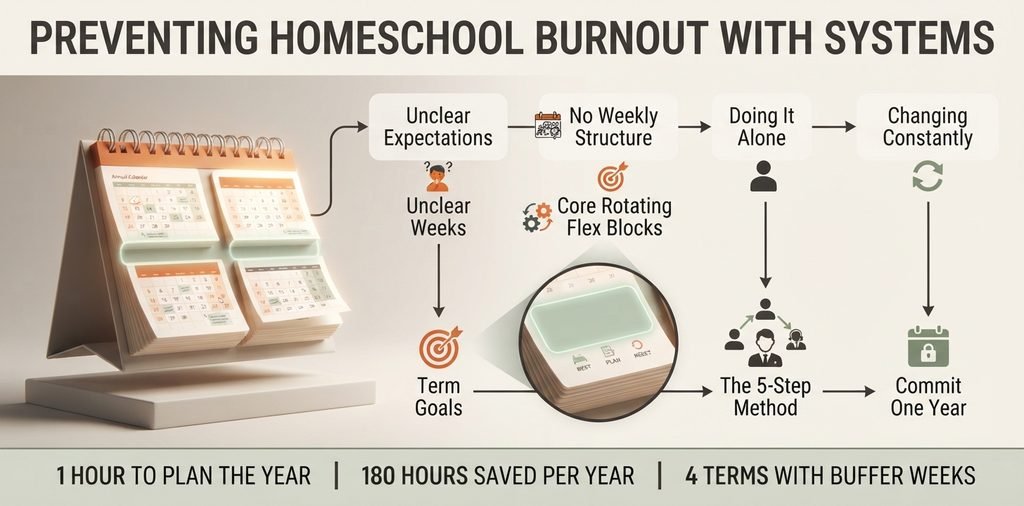
Quick answer: Homeschool burnout comes from mismatched expectations, unclear weekly structure, and lack of annual planning, not from lazy parenting. The 5-Step annual method, block scheduling with Core/ Rotating/Flex blocks, and weekly resets (not willpower alone) prevent burnout by reducing the constant friction that exhausts parents before September ends.
Why do homeschool parents burn out?
The word “burnout” suggests exhaustion. What actually exhausts homeschool parents is not the teaching itself. It is the invisible work of maintaining structure without structure to maintain.
A parent teaching three children across three different grade levels has to hold, in real time, the lesson plan for each child, the pacing of each curriculum, the state requirements for record-keeping, the weekly schedule, and the emotional temperature of the family. All at once. All the time. With no system to hand off the holding.
When a parent has to invent the system weekly instead of running the system that already exists, burnout is the natural result. It is not that the parent is weak. It is that the architecture is missing. The National Home Education Research Institute tracks homeschooling trends and family outcomes precisely because this workload is real and worth studying, not a personal shortcoming.
The Sunday night problem
For many families, the “homeschool burnout” moment feels like it arrives at one specific time: Sunday afternoon. The week has no written shape. The day ahead is unknown. The parent sits down to plan and has no template for what to plan, no previous week to compare against, no annual direction to align the week toward.
The planning takes three hours. The family gets one week of semi-organized work. Friday arrives and the parent realizes that the plan did not account for the child who moves slowly, or the curriculum that requires more days than the syllabus suggested. By Saturday, the plan is half-gone. Sunday night arrives again with the same blank slate.
This is not about motivation. This is about a system that needs to be reinvented every seven days.
The mid-year curriculum pivot
Another version of homeschool burnout arrives in month four, five, or six of the school year. The curriculum that seemed like a perfect fit in July is not working now. It moves too fast, or the child is bored, or the format does not match how your family learns.
A parent without an annual framework makes a curriculum change and hopes the rest of the year absorbs it. A parent with a year already divided into four terms knows exactly which term ends soon, whether the next term goal needs adjustment, and whether skipping a unit in this term can be made up in the buffer week between terms. The change is a decision, not a crisis.
Without that annual shape, every curriculum decision feels risky. The uncertainty alone exhausts.
How do systems prevent burnout: what’s the 5-Step annual method?
The 5-Step annual method is real. It lives in the full product, and it solves the burnout problem at the root by removing the need to reinvent the year every Sunday night. The method has five steps, takes about one hour, and builds the entire year’s skeleton in a single sitting.
The 5 steps in order
Step 1 starts with the dates you do not get to choose: your state’s minimum instructional days, holidays you already know about, and any family plans booked months in advance. Write these directly on the annual calendar before anything else.
Step 2 divides the remaining teaching weeks into four terms of eight to ten weeks each. These terms give you checkpoints smaller than a year but bigger than a week. If a curriculum is not working, you have nine weeks to notice, not thirty-six.
Step 3 sets one to three goals per term per child. Not twelve goals. Not a vague wish like “get better at math.” Something specific: “finish the phonics workbook” or “complete four science experiments.” A term goal gives every weekly plan a target to point at before the week even starts.
Step 4 builds buffer weeks between terms, ideally at existing holiday breaks. These are not vacation days by default. They are shock absorbers. When a curriculum runs long, or a child needs a reset week, or life happens, a buffer week gives the plan room to adjust without cascading failure into the next term.
Step 5 is a five-minute sanity check. Look at the whole year and verify: no term is longer than ten weeks, every child has term goals, and at least one buffer week exists before the year ends (not just at the very end when it is too late to use).
Systems matter: A parent who plans the year this way spends one hour in July but saves three hours every Sunday night for thirty-six weeks. That is one hundred eighty hours of planning time recovered. It is also thirty-six weeks of knowing what comes next, instead of inventing it from scratch.
Weekly structure that does not require reinvention
Once the year has a shape, the week gets simpler. A calendar for the week does not need to contain every decision. It contains the day’s work divided into three kinds of blocks: Core, Rotating, and Flex.
Core blocks are the work that happens every single day. These are not all subjects. Core is the non-negotiable floor: the reading lesson, the math lesson, maybe a character practice. Core happens at the same time each day because the parent has taught it so many times that the routine is invisible. The child knows what comes next without being told.
Rotating blocks are the subjects that happen on a schedule but not every day. A family might do history on Monday and Friday, science on Tuesday and Thursday, and art on Wednesday. The block itself is routine (history always at 10 a.m. on its days). The content rotates through the week. This pattern reduces the cognitive load on the parent. Once the rotation is written, the parent does not have to ask every morning, “Which subject should we do today?”
Flex blocks are the buffer time for reading aloud, field trips, projects that run long, or a child who moves slower than the schedule predicted. Flex time is not laziness. It is resilience. When flex time exists and gets used, the parent does not feel behind. The plan absorbed the reality of how long things really take.
Putting the three blocks into a weekly template
| Block type | What it contains | When it happens | Why it matters |
|---|---|---|---|
| Core | Reading, math, core academics | Same time every day | Routine requires no daily decision-making |
| Rotating | History, science, art, electives | Fixed days of the week | Schedule is visible but content varies |
| Flex | Buffer, projects, catch-up, reading aloud | Unscheduled but reserved | Absorbs real life without breaking the plan |
A weekly view with these three block types written out once becomes a template. The parent prints it or writes in the details, and the structure is already there. Sunday night stops being a blank slate.
What are the real causes of homeschool burnout, and what fixes them?
Homeschool burnout has root causes. Identifying them reveals what needs to change.
Structural causes: missing systems
Burnout from unclear expectations: a parent begins the year without knowing how many subjects to teach, how many days per week, or what “done” looks like for the year. The fix is the 5-Step annual method and term goals. Specificity removes the constant doubt.
Burnout from lack of structure in the week: a parent plans ad-hoc, reinventing the daily schedule every Sunday or every morning. The fix is the Core/Rotating/Flex block system. Written once, used all year.
Burnout from teaching multiple grades alone: a parent has one child in first grade, one in fourth, and one in seventh, and they all need something different at the same time. The fix is the annual method (each child gets separate term goals) plus the weekly structure (Core blocks can happen at the same time for all children if the level is adjusted; Rotating blocks can be staggered if needed). See the guide on homeschooling multiple grades for detail.
Situational causes: the wrong fit for your family
Burnout from managing full-time work and homeschooling: a parent works outside the home and has limited hours for teaching. The fix is ruthlessness about Core vs. Rotating vs. Flex. See the guide on homeschooling while working full-time for how successful families structure this.
Burnout from changing systems constantly: a parent buys a new planner every September, tries a new curriculum model in October, switches to a new app in November. The fix is committing to one system for one full year. If the system does not work after a real trial, change it. But changing it every month guarantees burnout because you are learning a new system instead of using one that already works.
Burnout from using a system that does not match your family: a parent chooses a digital homeschool planner designed for families who plan across multiple devices, but their family plans at one desk. Or they choose a [printable homeschool planner] (https://homeschoolplanhub.com/printable-homeschool-planner/) designed for families who plan by hand, but they work better with cloud sync. The fix is knowing your family’s actual workflow before choosing the tool. Take the approach that matches how your family plans, not how you think you should plan.
When are systems not enough, and when should you talk to someone?
Systems reduce friction. They do not eliminate every moment of overwhelm. If homeschool burnout persists even after building the annual plan, setting term goals, and establishing weekly structure, it is worth talking to a therapist or counselor. Burnout can reflect real stress patterns or anxiety that a planner alone cannot address. A professional who works with parents can help you sort out what is a system problem versus what is something else.
This one change does not replace professional care. It complements it.
What’s the real value of the 10-Minute Weekly Reset?
One more tool prevents burnout: the 10-Minute Weekly Reset. This is a brief review at the end of the week, usually on Friday afternoon, that takes ten minutes but prevents the Sunday night panic.
In the reset, a parent looks at the week that just ended and asks: Did we do what we planned? Which Core blocks happened consistently? Which Rotating blocks were skipped or moved? Did Flex time get used, or did the week move exactly as planned?
Then the parent writes one sentence about what to carry forward or change for next week. Not a new plan. Just an adjustment to the existing template.
By Friday, Sunday night is no longer a blank slate. It is a small adjustment to something that already exists. The planning time drops from ninety minutes to fifteen. The parent does not carry the entire week in their head. The weekly structure carries it.
Pace matters: A parent who spends one hour building the annual plan, fifteen minutes on a weekly reset every Friday, and zero extra planning on Sunday night is doing ninety percent less planning work than a parent who plans the whole week from scratch every Sunday.
Is homeschool burnout preventable with the right structure?
Homeschool burnout is not a sign of weakness or lack of commitment. It is a signal that the structure does not match the reality. When the structure does fit, teaching feels possible. Not every day feels easy. But the week has shape, the year has direction, and the parent is not holding everything in their head at once.
The 5-Step annual method and weekly block scheduling exist in the full [homeschool planner] product. These are not theories. They are systems dozens of families use every year. If you want to try the method first, the free 10-Minute Weekly Reset lead magnet gives you the weekly structure template to test. No card required.
Burnout is not inevitable. It is the signal that it is time to build a system instead of relying on willpower and hope.
Homeschool burnout: FAQ
Is homeschool burnout the same as depression?
Burnout and depression are different. Burnout is exhaustion from a system that does not work. Depression is a clinical condition that affects mood, energy, and ability to function. Both can exist at the same time, and both deserve attention. If you suspect depression, talk to a doctor or therapist. If you suspect burnout alone, the fix is usually structural: rebuild the system, reduce the scope, or adjust the approach. Burnout tends to lift within days or weeks once the underlying structure changes, since the exhaustion was tied to the workload, not to brain chemistry. Depression doesn’t resolve the same way, even after a schedule improves, which is one of the clearer signs it’s worth a professional opinion rather than another round of system tweaks. Neither one is a personal failing, and treating burnout as purely a discipline problem, or depression as something a better planner can fix, usually delays getting the right kind of help.
Can homeschool burnout happen if I love teaching?
Yes. You can love teaching and still burn out. Burnout does not come from disliking the work. It comes from doing the work without a structure that makes the work sustainable. A parent can love teaching but burn out from planning every week from scratch, or from managing five children with five different plans, or from using a system that does not match their workflow. The mismatch between loving the work and burning out from it is exactly why burnout gets dismissed so often; a parent assumes that if they still enjoy teaching, they can’t actually be burned out, and pushes through instead of addressing the missing structure. Recognizing that the two aren’t connected is often the first step toward actually fixing the system instead of second-guessing whether the burnout is even real.
How long does it take to recover from homeschool burnout?
If burnout is caused by structure, the fix starts immediately. Building the annual plan takes one hour. Implementing the weekly block system takes one week. By the second week of using the new structure, most parents report that Sunday night feels different. The recovery is not about motivation returning. It is about the cognitive load dropping. This timeline assumes the structural fix actually gets implemented consistently, not tried for a few days and abandoned when the old habits feel more familiar. Families who stick with the new weekly structure through that first rocky week tend to see the shift hold, since the reduced cognitive load compounds once planning stops requiring a fresh decision every single day. Give the new structure at least two full weeks before judging whether it’s working.
Do I need a special planner to prevent homeschool burnout?
You need a system. The system can be a printable PDF, a digital app, a spreadsheet, or a notebook. What matters is that the system has an annual view divided into terms, term goals per child, a weekly template with Core, Rotating, and Flex blocks, and a space for a Friday reset note. Not every planner has all four. If yours does not, you can add them. The specific tool matters far less than whether these four pieces exist somewhere in your system. A beautifully designed planner missing the annual view or the Friday reset space still leaves the core burnout drivers unaddressed, while a plain notebook with all four pieces in place can outperform an expensive app that’s missing the structure that actually prevents burnout.
What if my child resists the schedule?
Children sometimes resist structure at first because change is unfamiliar. The Core, Rotating, Flex block system usually works better than ad-hoc planning because the child knows what comes next. If a specific subject is being resisted, the block system makes it easier to see why and adjust. Maybe the Core block for that subject needs to move to a different time. Maybe it needs to be shorter. The system gives you data instead of guessing. Give a new system two to three weeks before concluding it isn’t working, since some initial resistance to any change, even a good one, is normal for most kids. If resistance continues past that adjustment window specifically around one subject, that’s a more reliable signal something about the block itself needs adjusting than a first-day reaction would be.
Can the 5-Step method work for high school homeschooling?
Yes. High school has more complex requirements, transcript tracking, credit hours, electives. But the same structure works. The annual method just divides the year into four terms instead of by semester. Term goals for high school look different, complete the US history textbook, earn one elective credit, but follow the same pattern. The main adjustment for high school is precision: terms need to map cleanly onto credit-hour and transcript requirements, not just cover material loosely. Setting up that mapping once, at the start of ninth grade, means the same annual method continues working through graduation without needing to be rebuilt each year. Reviewing the current core-course sequence before finalizing the term plan keeps both goals aligned from the start. This same mapping approach also makes it easier to spot a sequencing gap, like a missing lab science credit, early enough in the year to adjust without falling behind.
Where do I start if I am already burned out?
Start with the annual plan. Pick one afternoon, follow the 5-Step method, and let the calendar take the cognitive load. Do not try to change everything at once. Fix the year first. Then build the weekly structure. Then introduce the Friday reset. One change at a time works better than a full overhaul. Resist the urge to research every possible system before starting; the annual plan itself takes one afternoon, and starting imperfectly this week beats spending another month comparing planners while the burnout continues. The goal in week one isn’t a perfect system, it’s just enough structure to stop the Sunday night scramble that’s driving the exhaustion. Give yourself permission to start with just the annual plan this week rather than the whole system at once.
Homeschool burnout is not your failure. It is a signal to change the system
If you are reading this because you are burned out, or on the edge of it, the first thing to know is that it is not a personal failure. The system needs change, not you.
Start with the free 10-Minute Weekly Reset to see how the block structure works. If the block system helps, the full homeschool planner includes all three tools: the annual method, the weekly template, and space for your child’s individual term goals.
Homeschool burnout is preventable. You do not need willpower. You need structure. Build it once, use it all year, and teach without running on empty.
Try the 10-Minute Weekly Reset
Already tried a spreadsheet or an app that didn't stick? This free checklist is built for a week with more than one grade in it — the exact method from the HomeschoolPlanHub system, no card required.
or see every option, free to $49 — See Pricing