DIY Homeschool Room Ideas on a Budget
Try the 10-Minute Weekly Reset
Already tried a spreadsheet or an app that didn't stick? This free checklist is built for a week with more than one grade in it — the exact method from the HomeschoolPlanHub system, no card required.
or see every option, free to $49 — See Pricing
DIY homeschool room ideas are low-cost setups you build yourself. They use furniture, bins, and wall space you mostly already own. You do not need a spare bedroom, a wall of matching cube shelves, or a laminator. You need a spot where the work lives, storage your kids can reach, and a way to clear it when the day ends. This guide covers real setups for apartments, shared dining rooms, and single corners. It also covers what to buy, what to skip, and how to make one room work for several grades.
Most of the picture-perfect classrooms you see online cost hundreds of dollars. Many get abandoned by October. A working homeschool room is usually plainer and cheaper. It is built around one question: when a lesson ends, how fast can this table go back to being a table?
Do you need a dedicated homeschool room?
No. Most homeschooling families do not set aside a room only for school. The ones who do often find their kids drift back to the kitchen table anyway. A dedicated room is a convenience, not a requirement. What matters is a consistent place to work and a consistent place to store materials. That place can be a cart in the corner of the living room.
If you are just getting started with homeschooling, do not buy furniture first. Run six weeks with what you have. You will learn where your kids really sit, which subjects make the most mess, and how much storage you need before you spend a cent.
DIY homeschool room ideas for small spaces and apartments
Small-space homeschool rooms work when the school gear is mobile and the surface is shared. Three setups cover almost every apartment or tight house.
The dining table that resets in five minutes
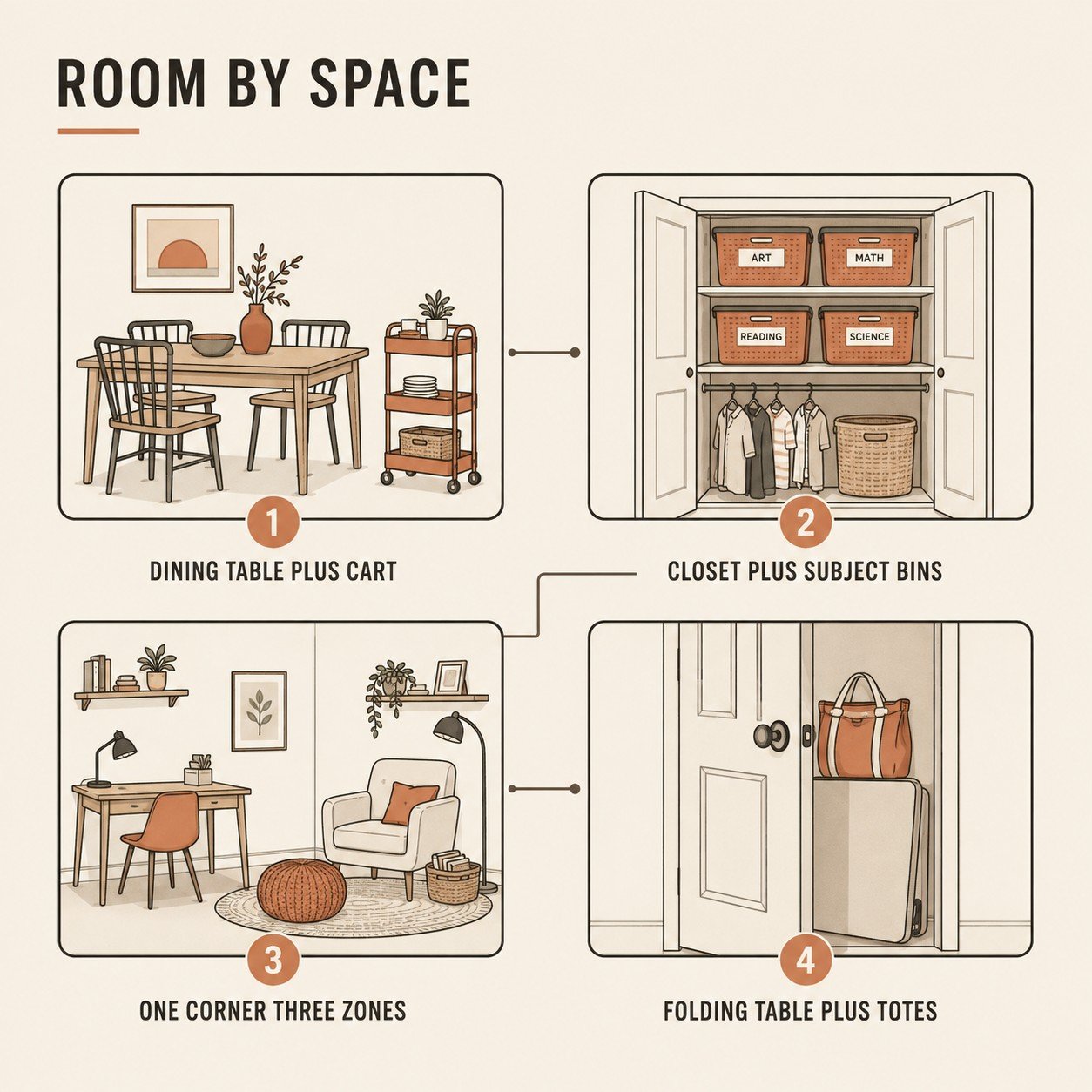
The most common DIY homeschool room is the table you already eat at. Pair it with a rolling cart or stackable drawers against the nearest wall. Each child gets one drawer or one caddy. Everything for the day comes out at the start and goes back before lunch. One rule makes this work: the table is clear before you move to the next thing.
Cost stays low. The table is free, and a three-drawer rolling cart runs about 20 to 40 dollars. Add clipboards or lap desks. Then a child can move to the couch for reading without losing their page.
The learning closet or cabinet
A coat closet, a pantry shelf, or a cheap cabinet with doors becomes a homeschool room that disappears when company arrives. Fit it with adjustable shelves. Group supplies in labeled bins by subject. Keep this week’s work at eye level. The doors close on the visual clutter, which is the part that wears parents down.
This setup pairs with any nearby table. The closet is storage, not a workspace, so no child has to sit inside it.
One corner, three zones
If you can give up one corner for good, split it into three small zones without building anything. Put a desk or small table for focused work. Add a floor spot with a rug for messy projects and read-alouds. Set a chair or floor cushion for independent reading. Low shelving or a sideways bookcase separates the zones and doubles as storage. A child stuck on math can move to the reading chair for ten minutes without leaving the area.
DIY homeschool room ideas by the space you have
The right setup depends on the square footage you can commit. This table matches each situation to a build, a rough starting cost, and the family it suits best.
| Space you have | DIY setup | Rough cost | Best for |
|---|---|---|---|
| Shared dining table | Table plus one rolling cart or drawer set per child, clipboards for couch work | 20 to 60 dollars | Apartments, one to three kids, families who eat where they learn |
| One closet or cabinet | Adjustable shelves, labeled subject bins, current week at eye level, doors close | 15 to 50 dollars | Small homes, parents worn down by visible clutter, frequent guests |
| One permanent corner | Small desk, floor rug, reading chair, sideways bookcase as a zone divider | 40 to 120 dollars | Kids who need to move between tasks, mixed ages sharing one area |
| Spare room | Two wall-mounted desks or one long table, wall bookshelves, a supply station, a wall calendar | 100 to 300 dollars | Three or more kids, families staying in one home long term |
| No spare surface at all | Folding table stored behind a door, one labeled tote per child, a wall pocket chart | 25 to 70 dollars | Very tight spaces, renters, families who school in a different room each day |
DIY homeschool room ideas on a budget
Buy the surface and the storage first, and buy them used. A solid table, sturdy chairs at the right height, and one storage unit per child will carry you through years of homeschooling. Everything else is optional.
- Table or desks. Thrift stores, marketplace listings, and office liquidation sales sell tables for a fraction of retail. A child needs a stable surface at elbow height, not a themed school desk.
- Chairs. Feet flat on the floor, knees at a right angle. If the chair is too tall, add a footrest made from a stack of old books or a crate.
- Storage. Rolling carts, cube shelves, and dressers with wide drawers all work. One unit per child keeps arguments down.
- Rug. A cheap washable rug marks the messy-project and read-aloud zone and saves your floor.
Skip the flexible seating collection for now. Skip the classroom rug with the alphabet border. Skip the coordinated bin labels until you know the room is staying. Those purchases feel productive and rarely change how much learning happens.
Storage that holds a homeschool
Good homeschool storage is sorted by subject, reachable by the child who uses it, and easy to reset in under five minutes. Three habits do most of the work.
Sort by subject, not by kid. One bin for math, one for language arts, one for science supplies. Shared bins mean you buy one set of colored pencils instead of three. Materials also stop vanishing into a single child’s room.
Put the current week at the front. Whatever you use this week sits at eye level or in the top drawer. Next month’s unit lives higher up or in a closet. You are not hunting through everything to find today’s work.
Keep a home for the paper. Finished work goes into one folder or file box per child the moment they finish. So do samples for your state record keeping and anything a portfolio might need. Paper with no home is what turns a tidy corner into a pile.
Wall space is free real estate
Walls hold storage and reference material without taking a single square foot of floor. In a small homeschool room, the wall is where you win back space.
- Wall-mounted shelves keep books off the floor and out of the closet. A row of picture-ledge shelves costs little and holds a surprising number of readers.
- A fold-down or wall-mounted desk gives one child a personal work spot in a room with no space for another table. It folds flat when the day ends.
- Boards earn their spot: one whiteboard for the day’s plan, one bulletin board or pocket chart for anchor charts and current memory work. More than two boards becomes wallpaper.
- A wall calendar or command center holds the week’s plan where everyone sees it. A printed planner page in a clip frame works as well as anything you can buy.
If you want the wall page to match what you carry day to day, our printable homeschool planner is built to be posted, clipped, or kept in a binder on the shelf.
DIY homeschool room ideas for multiple kids and grades
A room for several grades works when loud work and quiet work are separated and each child has an independent spot. You are managing sound and sight lines, not building separate classrooms.
- Split the noise. Put the read-aloud rug and group table on one side, independent work stations on the other. A younger child doing a hands-on activity should not sit next to an older one trying to write an essay.
- Give each child a station. One drawer, one wall pocket, and one seat that is theirs. Even in a shared room, this cuts down on territory fights.
- Use headphones. A cheap pair for audiobooks or math practice lets one child work while you teach another.
- Stagger the hard subjects. If you are teaching multiple grades at once, schedule the subject that needs you most for each child at a different time. Then the room only has one child needing help at a time.
What not to buy: the Pinterest classroom trap
The homeschool rooms that get photographed are not the ones that get used. Before you copy a setup you saw online, look at what it is really selling you. Matching furniture, a color scheme, and a wall of decor that a child ignores by week three. Browsing other families’ small-space room tours is useful for ideas. Copy the storage logic, not the shopping list.
Spend on the table, the chairs, and one storage unit per child. Borrow or improvise the rest for a term. If the room still works in the spring, add the rug you wanted. Most families find the plain version is the one they keep.
Once the space is settled, the daily plan is the next piece. The full 36-week homeschool planner gives every child a page and every subject a place, so the room you built has something to run on.
Frequently asked questions
What are DIY homeschool room ideas?
DIY homeschool room ideas are self-built learning setups that use furniture and storage you already own or can buy secondhand, instead of a purpose-built classroom. Common versions include a shared dining table paired with one rolling cart per child, a coat closet or cabinet fitted with labeled subject bins, a single permanent corner divided into a work zone and a reading zone, and a folding table that stores behind a door. The goal is a consistent place to work and a consistent place to store materials that resets in about five minutes when the school day ends. A dedicated room is a convenience, not a requirement. Most homeschooling families run a full year without one by keeping their school gear mobile and their work surface shared with family life.
How do you set up a homeschool room in a small space or apartment?
Start with a shared surface and make the school supplies mobile. The dining table works as the desk if each child has a rolling cart or drawer set against the nearest wall. It comes out at the start of the day and goes back before lunch. Use wall space instead of floor space: picture-ledge shelves for books, a fold-down desk for one child, and one whiteboard for the daily plan. If visible clutter wears you down, move storage into a closet or cabinet with doors that close. Give up one corner for good if you can, and split it into a small work table and a floor rug for reading and projects. Expect to spend 20 to 70 dollars if you buy the cart and clipboards used, since the table and chairs are already in the home.
What furniture do you actually need for a homeschool room?
You need a stable surface at elbow height, chairs that let a child sit with feet flat and knees at a right angle, and one storage unit per child. That is the whole list. A thrifted table, sturdy secondhand chairs, and a rolling cart or dresser with wide drawers will last for years of homeschooling. A cheap washable rug is worth adding to mark the messy-project and read-aloud area. Everything else is optional and can wait until you know the room is staying. That includes flexible seating collections, themed school desks, classroom rugs with alphabet borders, and coordinated bin labels. Those purchases feel productive but rarely change how much learning happens. Buy the surface and the storage first, buy them used, and improvise the rest for a term before spending more.
How do you organize a homeschool room for multiple children?
Separate loud work from quiet work and give every child an independent station. Put the group table and read-aloud rug on one side of the room and independent work spots on the other. Then a younger child doing a hands-on activity is not next to an older one writing an essay. Each child gets one drawer, one wall pocket, and one seat that is theirs, even in a shared room, which cuts down on territory fights. Sort storage bins by subject rather than by child, so you buy one set of supplies instead of three. A cheap pair of headphones lets one child use an audiobook or math app while you teach another. Finally, stagger the subjects that need you most, so that at any moment only one child is waiting for your help.
Try the 10-Minute Weekly Reset
Already tried a spreadsheet or an app that didn't stick? This free checklist is built for a week with more than one grade in it — the exact method from the HomeschoolPlanHub system, no card required.
or see every option, free to $49 — See Pricing