Homeschool Discounts and Freebies: Where Do You Find Them?

Try the 10-Minute Weekly Reset
Already tried a spreadsheet or an app that didn't stick? This free checklist is built for a week with more than one grade in it — the exact method from the HomeschoolPlanHub system, no card required.
or see every option, free to $49 — See Pricing
Homeschool discounts and freebies exist everywhere once you know where to look. Many families struggle not because options don’t exist, but because no single place lists which programs work reliably, which stores honor a homeschool ID, and which online services were built specifically for homeschooling families on a budget. This guide brings them together in one place so you can find and claim money-saving programs without spending hours hunting.
Most of these deals need one thing upfront: the right credential. A valid homeschool ID card opens doors to museum discounts, bookstore programs, and state-specific teacher supply stores that would otherwise stay off-limits. The first step for any family seeking homeschool discounts and freebies is to get a free printable ID card in hand. Once you have that, the rest of this guide becomes immediately useful, and you can start saving money the same week.
Saving as a homeschool family also means knowing which programs fit your real teaching approach and which stores in your area accept homeschool documentation without extra questions. This guide covers both the foundational discounts that work anywhere and the state-specific programs that unlock deeper savings once you know they exist.
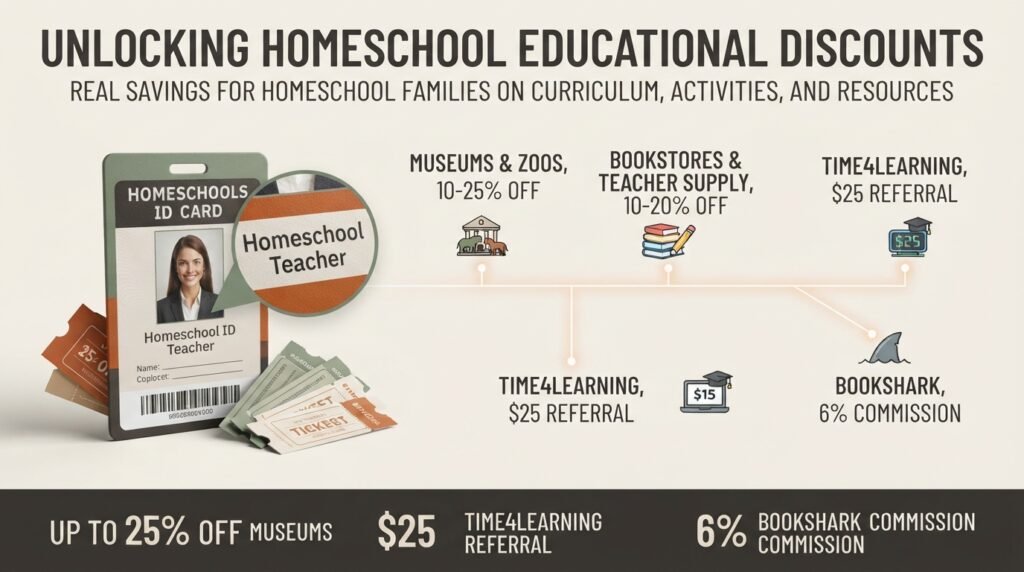
Quick answer: Get the free homeschool ID card first. It unlocks 10 to 25 percent off museums and zoos and 10 to 20 percent off teacher supply stores. Online, Time4Learning and Outschool run their own referral credits, no ID needed.
<!– featured image: family-discount-id-card.jpg or similar (family holding homeschool ID card, receipt, or using a discount code online) –>
Why start with a homeschool ID card for in-person homeschool discounts and freebies?
A homeschool ID card serves as the foundation for claiming homeschool discounts and freebies at physical locations. Most museums, zoos, bookstores, and teacher supply stores will honor it. The card needs to look professional and real. A hand-drawn card or a screenshot on your phone will not work anywhere. A printed, laminated card with your family’s information will work in shops nationwide.
We created a free printable homeschool ID card specifically to unlock these savings. This homeschool discounts and freebies resource includes space for both a teacher ID and student ID, matches the format that physical locations recognize without question, and requires only a quick email signup to download. Download the free homeschool ID card before visiting any store where you want to claim a discount.
Having your card with you makes a real difference. Many stores check for exactly this format when you ask about homeschool discounts and freebies. With it ready in your wallet, the conversation feels less awkward and the employee can approve your discount without running to a manager. Print it on cardstock (regular paper feels flimsy and raises questions), then laminate it or put it in a protective sleeve. This simple step turns a list of potential homeschool discounts and freebies into actual money in your hand when you need it.
What real-world homeschool discounts and freebies exist at physical locations?
When you have your homeschool ID card ready, you can start claiming homeschool discounts and freebies at hundreds of stores and locations. The key is knowing which places offer them and how much money you save by using them throughout the year. Below are the most reliable categories where homeschool families see real savings.
| Category | Typical discount | What you need |
|---|---|---|
| Museums and zoos | 10 to 25 percent off admission | Homeschool ID card |
| Bookstores and teacher supply stores | 10 to 20 percent off | Homeschool ID card |
| State official ID programs | Varies, often deeper than a generic card | State-specific registration |
| Movie theaters and entertainment venues | Matinee or group pricing | Ask directly, varies by venue |
Museum and zoo memberships with homeschool pricing and discounts
Many museums and zoos offer separate homeschool pricing or family packages that cost less than individual admissions. The exact savings varies by location, but homeschool families with valid ID often get ten to twenty-five percent off admission prices. Some zoos offer annual homeschool passes that let a family visit unlimited times for a single annual fee. If your family visits monthly, these annual passes pay for themselves in two or three visits.
Homeschool discounts and freebies like these make field trips affordable. Check your local museums directly. They often promote homeschool pricing on their websites, though not always prominently. When you visit, bring your homeschool ID card and ask at the entry desk about homeschool discounts and freebies on admission. Larger institutions sometimes run special homeschool days with additional programming built around school holiday schedules. On these days, you get extended hours or bonus activities for the same discounted price.
Bookstores and educational retailers offering homeschool discounts
Chain bookstores like Barnes and Noble have historically offered teacher discounts to educators, which sometimes extend to homeschool parents with proper credentials. The specific policy varies by store location and changes periodically, so it is worth calling ahead. Many independent bookstores have their own homeschool discount programs that are not advertised nationally but will apply once you show your homeschool ID. Some independent bookstore owners themselves homeschooled and built these programs specifically for families like yours.
Teacher supply stores like Lakeshore Learning accept homeschool teacher IDs. They offer ten to twenty percent discounts on classroom supplies. For a homeschooling family, this means planners, manipulatives, decorations, and classroom organization tools. These purchases make teaching easier and spaces more functional. Educational supply websites often run homeschool discount codes during back-to-school season. Search for “homeschool teacher discount [store name]” before buying anything. The codes rotate and expire frequently. Some sites offer better discounts in July and August than in October. Timing bigger purchases around these windows saves money.
State-specific programs and official homeschool ID programs by state
Some states recognize homeschool families through official homeschool ID card programs that unlock more homeschool discounts and freebies than a generic card alone. These programs exist in Texas, North Carolina, Florida, and a few other states. Families participating in these official programs get access to additional discounts that general homeschool IDs do not unlock. Some states have direct partnerships with state museums, science centers, and educational vendors that offer special pricing only to their official cardholders.
Check your state’s homeschool regulations through the homeschool requirements by state guide to see if your state has an official program and which homeschool discounts and freebies it qualifies you for. Some states’ official homeschool ID programs also include reciprocal museum agreements with other states, so if you travel, your ID might work for discounts out of state.
Movie theaters and entertainment venues with family homeschool packages
Some independent movie theaters and performing arts venues offer homeschool family packages. These deals vary widely by venue, but a homeschool ID card sometimes gets you into matinee pricing or group rates even for small groups of two or three kids. Call your local theaters to ask specifically about homeschool pricing. Performing arts centers that host traveling shows often have special educational packages they do not advertise widely but will offer to families asking about homeschool discounts and freebies.
How do homeschool discounts and freebies work differently for online learning programs?
Online learning changes how homeschool discounts and freebies work. Rather than needing a physical ID card, homeschool families can access savings directly through enrollment in programs built specifically for homeschooled students. Several platforms combine real value with easy access to homeschool discounts and freebies.
Time4Learning offers homeschool discounts through affiliate referrals
Time4Learning is a video-based curriculum platform designed specifically for homeschooling families. It covers subjects from kindergarten through high school. Each course includes structured daily lessons and auto-graded quizzes. Families who sign up through homeschool partner referral channels unlock special introductory pricing and benefits. Direct enrollments do not include these same offers.
As a partner program, we can introduce families to Time4Learning. Each family that signs up this way helps us create and maintain free resources. These resources include the [homeschool ID card](https:// homeschoolplanhub.com/downloads/free-homeschool-id-card/) that helps unlock physical-world homeschool discounts and freebies. Time4Learning contributes $25 for each new family signing up through a referred enrollment link.
The important point for your family: the subscription cost is identical whether you enroll directly with Time4Learning or through our referral. You receive the full pricing benefit either way. By using our referral link, you help us continue creating free content and resources at no extra cost to you.
Outschool live classes and referral homeschool discounts and freebies
Outschool connects homeschooling students with live online teachers across hundreds of different subjects. Topics range from academic subjects to sports, music, art, and creative writing. Classes typically range from one to eight weeks in length. Most meet once per week, though more frequent options exist. Outschool runs regular promotions for new students. These include discount codes that reduce the price of a first class significantly.
As a partner, we can send families toward Outschool with a referral code that includes a $15 credit for a new family. Your first class (or several first classes, depending on timing) costs substantially less than the full published price. Individual classes on Outschool typically run from $10 to $40 per session depending on the teacher, subject, and class size. A $15 credit often covers an entire first class, making it a low-risk way to try a new subject or teacher. Once you find classes that work for your family, you can enroll in ongoing sections at full price. The first experience costs very little.
BookShark literature curriculum with affiliate-based homeschool discounts and freebies
BookShark sells literature-based reading curricula paired with physical books that ship to your home. Instead of requiring subscriptions, BookShark uses an affiliate commission structure. Families who purchase through affiliate links support creators and communities recommending the program while paying the full listed price. BookShark offers six percent commission to affiliates. Each family that purchases through this guide generates a small contribution back to this project and helps us continue creating free homeschool resources.
BookShark does not charge you any extra fee for coming through an affiliate referral link. You pay the exact same price you would if you went directly to their website. Affiliate commissions are BookShark’s standard way of supporting content creators and communities that recommend their books. If you love literature-based learning and were planning to use BookShark anyway, using an affiliate link costs you nothing and helps fund free homeschool resources.
| Partner | What it is | What you get | You pay |
|---|---|---|---|
| Time4Learning | Video-based curriculum, kindergarten through high school | $25 goes toward our free resources | The same price as enrolling directly |
| Outschool | Live online classes across hundreds of subjects | $15 credit toward a new family’s first class | The same price as enrolling directly |
| BookShark | Literature-based reading curriculum with physical books | Six percent commission funds our free resources | The same listed price |
What state homeschool discounts and freebies exist through testing programs and co-ops?
Compliance requirements are often hidden from families unless they look hard. Several states offer discounts on required standardized testing or portfolio review services for homeschooling families. Other states offer small grants or tuition assistance for specific subjects or grade levels.
Check your state’s homeschool law through the [homeschool requirements by state](https://homeschoolplanhub.com/ homeschool-requirements-by-state/) guide to see whether your state has testing requirements and which testing companies offer homeschool pricing. Some states recognize co-ops and umbrella schools. These organizations often offer group purchasing discounts on curricula that individual families cannot access on their own.<!– image: family-learning-online.jpg (student using a computer or tablet, parent nearby) –>
What discounts exist for families homeschooling multiple children at once?
Running school for more than one child shifts the economics of discounts. Multi-child families often get better per-child rates from curriculum providers. Some publishers offer “additional student” discounts that bring the price down significantly for the second, third, or fourth child.
Bulk curriculum vendors run bundle deals throughout the year, especially around back-to-school season. Families with homeschooling multiple grades at once can often purchase a suite of products together and get better overall pricing.
Membership programs like Amazon Prime sometimes include discounts on curriculum supplies when ordered through their marketplace sellers. Curriculum fairs, both in-person and online, are held monthly. They offer direct-from-publisher discounts that sit between the full retail price and what you find in bulk retailers.
What homeschool record-keeping programs offer free trial periods?
Most record-keeping software includes attendance trackers, portfolio builders, and transcript makers. Many offer free trial periods. Some offer permanent free tiers that work for small families. A homeschool family can often build a complete digital record-keeping system using free trial periods without paying anything upfront.
The challenge is timing. A family should know how long each trial lasts and whether the tool exports the data if the trial ends and the family does not pay. Our [homeschool attendance tracker](https://homeschoolplanhub. com/homeschool-attendance-tracker/) is available for purchase, but so are dozens of free and trial-based alternatives if you want to explore options first. The same applies to [transcript and GPA calculators](https:// homeschoolplanhub.com/homeschool-gpa-calculator/) and [curriculum trackers](https://homeschoolplanhub.com/ homeschool-curriculum-tracker/).
What discounts come from memberships and professional organizations?
Organizations like the Home School Legal Defense Association (HSLDA) and regional homeschool co-ops offer membership discounts on curricula, testing, and professional services. These memberships vary in cost. Some are free while others charge annual fees. They unlock access to group purchasing that brings individual prices down.
Your state or local homeschool association may run group purchases at discount prices. Ask whether your local co-op or homeschool group negotiates curriculum pricing on behalf of members. Many do. The deals come through internal member emails, not public websites, so only members know about them.
What free webinars, courses, and educational resources are available?
Educational platforms regularly offer free courses and webinars for homeschooling families. YouTube channels, podcasts, and websites dedicated to homeschooling education are often completely free. Paid courses sometimes offer free preview modules.
The most valuable free resources come from curriculum publishers trying to build trust with new families. Many providers of literature-based curricula, classical education materials, and Charlotte Mason resources publish free planning guides, teaching videos, and sample lessons. These resources cost nothing but save time.
How do you track and organize homeschool discounts and freebies for maximum savings?
Keep a spreadsheet or document noting which discounts work with your family’s real purchases. A discount that requires driving one hour away or buying something you would not normally purchase is not real savings. It is an expense in disguise. Real discounts are the ones you use repeatedly and the ones that save money on what you were already planning to buy. Start from a core homeschool supply list so the discounts apply to things you actually need.
Recap: Start with the free homeschool ID card. Use it for 10 to 25 percent off museums and 10 to 20 percent off teacher supply stores. Add Time4Learning, Outschool, or BookShark if they fit your curriculum. Check your state program for anything a generic ID does not unlock.
Organize discounts by time: which are seasonal, which run all year, and which are tied to specific events or membership periods. When a discount code expires or changes, update your notes. Share what you find with other homeschool families. The best discount is the one you discover and pass along to someone in your community who needs it.
Homeschool discounts and freebies FAQ
Getting started with homeschool ID cards
Where do I get a homeschool ID card to start claiming discounts? Download the free printable version from this site. Print it on cardstock, fill in your family’s information, and laminate it for durability so it holds up to being carried in a wallet or bag for a full year. This format is recognized by most museums, bookstores, and teacher supply stores, since they’re generally looking for a card that looks official and includes the standard fields, not a specific issuing authority. Some states also offer official homeschool ID cards through their homeschool associations, which can be worth checking if your state has an active one. Some states also offer official homeschool ID cards through their homeschool associations, worth checking if your state has an active one. Keeping a spare printed copy at home, not just the one in your bag, means a lost or damaged card never leaves the family without valid proof on short notice.
What information needs to go on a homeschool ID card? At minimum, your family name, a student name, a teacher or administrator name, the issue date, and an expiration date, typically one year from issue, cover what most locations expect to see. Many stores also appreciate a student or teacher photo, though they do not always require it, since the photo mostly just reinforces that the card belongs to the person presenting it. Our free template includes all the fields most locations check, so there’s no need to design a card from scratch or guess at what’s missing. Our free template includes all the fields most locations check, so there’s no need to design a card from scratch. Listing the current grade level or program name alongside the student’s name gives cashiers one more quick detail to match against a posted homeschool discount policy.
Do I really need a laminated ID card, or will a printed copy work? Most locations accept a printed copy if it looks official and includes the key information. Lamination protects the card and makes it look more legitimate. Some stores explicitly ask for a laminated card. Lamination costs a few dollars and pays for itself with the very first discount. Some stores explicitly ask for a laminated card specifically, and lamination costs a few dollars but pays for itself with the first discount. A basic plastic sleeve from an office supply store offers a middle option, protecting the card without the cost or hassle of a full lamination run. A quick wipe-down or a fresh reprint every few months keeps a non-laminated card looking presentable well past its first few uses.
Using discounts across different states
Do homeschool ID cards work in every state? They work most places, but some store policies vary by location, even within the same national chain. A museum in California may have a different homeschool discount policy than the same chain in Texas, since individual locations sometimes set their own rules beyond corporate policy. Always call ahead or ask at the counter before assuming a discount applies, rather than being surprised at checkout. Many stores accept homeschool IDs even if they do not advertise a discount, so it’s worth asking even where you don’t see a posted policy. Many stores accept homeschool IDs even if they don’t advertise a discount, so it’s worth asking even without a posted policy. Keeping a short note of which specific locations have confirmed the discount works helps a family build its own reliable list over a year of regular visits.
What if I move to a different state mid-year? Update your ID card with the new state and reset the issue date. Different states have different compliance requirements, so check the [homeschool requirements by state](https://homeschoolplanhub.com/homeschool- requirements-by-state/) guide for the new state’s rules. Some discounts may also change based on the new state’s homeschool associations and partnerships. These stay stable enough to plan around, but confirming your new state’s specific policies directly is worth the few minutes it takes rather than assuming the old state’s discounts carry over unchanged. Reprinting rather than editing the old card by hand keeps the document looking official, which matters more than people expect when a cashier is deciding whether to honor it.
Discounts for specific situations
Are there discounts if I homeschool while working full-time? Time-based discounts do not work differently for full-time working homeschool families, since discount eligibility is generally tied to homeschool status, not to a parent’s employment situation. Some online programs like Time4Learning or Outschool work well with a full-time work schedule because students progress on their own time, fitting instruction around whatever hours actually work for the family. The discounts available to those platforms apply equally, regardless of whether the enrolling parent works full-time, part-time, or not at all. The discounts available to those platforms apply equally regardless of whether the enrolling parent works full-time or not at all. Blocking out the same instructional window each day, even while working full-time, still helps a self-paced program actually get finished rather than sliding indefinitely. Checking the specific program’s own refund or pause policy before enrolling matters more for a full-time working family, since a missed week is more likely than for a stay-at-home schedule.
Can I use homeschool discounts if my child attends school part-time? This depends on your state’s rules and individual store policies, so there’s no single universal answer that applies everywhere. Some states define homeschooling as the primary instruction, allowing part-time students to qualify even while attending school part-time. Check your state’s definition and ask individual stores whether they accept students in hybrid situations, since a store’s own policy might be more or less flexible than the state’s legal definition. The answer varies by location, so confirming directly beats assuming either way. A store’s own policy might be more flexible than the state’s legal definition, so confirming directly beats assuming either way. Getting a store’s or program’s answer in writing, even just a quick email, avoids a repeat conversation with a different employee who gives a different answer next time. Some part-time programs also issue their own attendance letter, which can serve as useful backup documentation alongside the homeschool ID if a store asks for more than the card alone.
Do I lose discounts when a student graduates? A graduated high school student no longer qualifies for homeschool-specific discounts if the discount is based on enrollment status, since the discount is tied to being an active student, not to having once been homeschooled. Some organizations extend discounts to graduates completing their final year, softening the cutoff somewhat. Plan ahead if a child will graduate mid-school year and you want to use certain discounts before then, since timing a purchase or membership renewal before graduation can capture savings that disappear right after. Plan ahead if a child will graduate mid-school year and you want to use certain discounts before then. Checking a specific program’s own graduate policy directly, rather than assuming it matches another provider’s rule, avoids missing a benefit the family was actually still eligible for. Keeping the graduate’s old ID card on file, even after it expires, can still help resolve a dispute over eligibility for a purchase made just before the cutoff date.
Managing affiliate partnerships and free offers
Why do some of these resources mention affiliate commissions? This site uses affiliate partnerships to fund free resources like the homeschool ID card and content like this article. When a family enrolls in Time4Learning or purchases through a BookShark referred link, this site earns a small commission. The family pays the same amount they would if they enrolled directly. These partnerships help us keep resources free for families who cannot afford to pay. They are transparent, and you can always enroll directly with any provider if you prefer.
Are any of these discounts exclusive to families using this site? No. The discounts from stores, museums, and bookstores are available to any homeschool family with a valid ID card, regardless of where that card came from or which site the family found it on. The affiliate programs we mention, Time4Learning, Outschool, BookShark, are available to all families through the provider directly. You are simply getting a referral link here that sometimes includes an enrollment bonus that does not cost you anything extra, on top of whatever discount the program already offers. You are simply getting a referral link that sometimes includes an enrollment bonus at no extra cost to you. Comparing a referral link’s terms against enrolling directly, when the option exists, confirms there’s no hidden difference in price or program access either way. Reading the referral program’s own terms page once is usually enough to confirm this, rather than needing to re-verify it every time a new discount is mentioned.
How often do homeschool discounts change? Constantly. Store policies change, program pricing updates, and new discounts launch throughout the year, so treating any specific discount as permanent is risky. The foundational discounts include museum pricing, bookstore ID acceptance, and state programs. These stay stable over time, changing rarely if at all. Online platform promotions run on different timelines, often tied to enrollment seasons or limited-time campaigns. Check with individual vendors if you want the current promotion before enrolling, rather than relying on outdated information from an older article. Check with individual vendors if you want the current promotion before enrolling rather than relying on an older article. Bookmarking a specific vendor’s current promotions page, rather than relying on a saved discount code from months earlier, is the more reliable habit for pricing that changes often. Following a program’s own newsletter or social account is often the fastest way to catch a limited-time promotion before it expires unused.
Maximizing savings as a homeschool family
What is the single best homeschool discount for most families? The free homeschool ID card and a museum or zoo membership represent the best value for most families, combining a zero-cost item with one that pays for itself quickly. The ID card costs nothing beyond the time it takes to print and laminate it. Many museums offer annual homeschool passes or family pricing that pays for itself after two or three visits, especially for families who already visit regularly for science or history units. That combination alone saves most families money every year, without needing to chase down every possible discount out there. That combination alone saves most families money every year without needing to chase down every possible discount. Pairing the ID card with a library card, which is free everywhere and often overlooked, rounds out the two highest-value, zero-cost tools most families underuse.
Where should I start if my family is new to homeschooling? Start with the free homeschool ID card, since it’s free and takes only a few minutes to set up. Then identify which stores and programs your family uses daily, not the ones you think you should use, since a discount at a store you never visit saves nothing. Ask those specific vendors if they offer homeschool pricing, even if it isn’t advertised. This keeps you from chasing discounts that do not apply to your real spending, focusing effort where it actually pays off. This keeps you from chasing discounts that don’t apply to your real spending. Revisiting this same short list again around the six-month mark, once actual spending patterns are clearer, often turns up one or two discounts worth adding that weren’t obvious at the start. Writing that short list down somewhere visible, rather than keeping it in your head, makes it far more likely the family actually uses the discounts it identified.
Do discount codes work better at different times of year? Yes. Back-to-school season, July through September, brings the most aggressive discounts on curricula and supplies, as retailers compete for the annual wave of families buying for the new year. Holiday season brings promotions on gift-suitable items, useful for educational toys or books. Summer often has clearance pricing on the prior year’s materials. January sometimes has discounts tied to homeschool planning, aimed at families reorganizing for the second half of the year. Plan larger purchases around these windows when you can, rather than buying at full price out of season. Plan larger purchases around these seasonal windows when you can, rather than buying at full price out of season. Setting a calendar reminder a week or two before each seasonal window opens gives enough lead time to compare a few options before committing to a purchase.
How our homeschool planner connects to saving money
A homeschool planner built with a budget-conscious family in mind includes space to track which programs and resources work for your budget. Our planner has room to note which discounts you used and when they expired so you can plan ahead next year. The attendance tracker and curriculum tracker make it easy to document your compliance requirements, which sometimes unlock additional discounts. Tracking your teaching helps you decide which paid resources are worth the cost and which free alternatives work just as well.
The Free Homeschool ID Card is available as a free download on this site. The full [homeschool planner](https:// homeschoolplanhub.com/) includes all the record-keeping tools that help families keep track of compliance and discounts year after year
Try the 10-Minute Weekly Reset
Already tried a spreadsheet or an app that didn't stick? This free checklist is built for a week with more than one grade in it — the exact method from the HomeschoolPlanHub system, no card required.
or see every option, free to $49 — See Pricing