Homeschool Hours: How Many Do You Need?

Try the 10-Minute Weekly Reset
Already tried a spreadsheet or an app that didn't stick? This free checklist is built for a week with more than one grade in it — the exact method from the HomeschoolPlanHub system, no card required.
or see every option, free to $49 — See Pricing
Your state does not care how many days you sat at the table. Many states count homeschool hours instead, and that number is not the same thing as attendance. If you have only ever tracked days on a calendar, you may be short on the number that satisfies your law. This guide covers what counts as instructional time, how much your state requires, and how to log it without turning it into a second job.
Homeschool hours vs. homeschool days
These are two different requirements, and states pick one or the other, sometimes both. A day requirement asks how many days you taught. An hour requirement asks how much time you spent teaching, regardless of how many days that took. Our homeschool attendance tracker guide covers the day-based version. This guide covers the time-based version, because logging one does not automatically satisfy the other.
What counts as instructional time
Most states define instructional time broadly. Homeschool hours are not limited to a worksheet at the kitchen table. In most states, all of the following count toward your total.
- Textbook work, workbooks, and online courses
- Read-alouds and independent reading tied to a subject
- Hands-on projects, science experiments, and art tied to a lesson
- Educational field trips, museum visits, and co-op classes
- Music lessons, sports practice, and other structured activities with a learning goal
What does not count is time with no learning goal attached, like free play or a car ride with no discussion behind it. When in doubt, ask whether you could explain the purpose of the block if your state ever asked. If you can, log the time.
Homeschool hours by state
Requirements vary a lot, and some states set none at all. The table below shows common patterns. Always confirm your own state’s current law before relying on any number here. These rules change.
| State pattern | Typical requirement | What this means for your log |
|---|---|---|
| Hour-based (example: Ohio) | 900 hours a year grades one through six, 1,000 hours grades seven through twelve | Track total hours directly, not days |
| Hour plus day (example: Pennsylvania) | 180 days and 900 to 990 hours depending on grade | Track both, since one does not substitute for the other |
| Day-based only (examples: South Carolina, Louisiana) | 180 instructional days, no hour minimum stated | Days matter more here, but many families still log hours for their own planning |
| No stated minimum (examples: Texas, Alaska) | No required hours or days | Logging is optional, useful mainly for a portfolio or a future transcript |
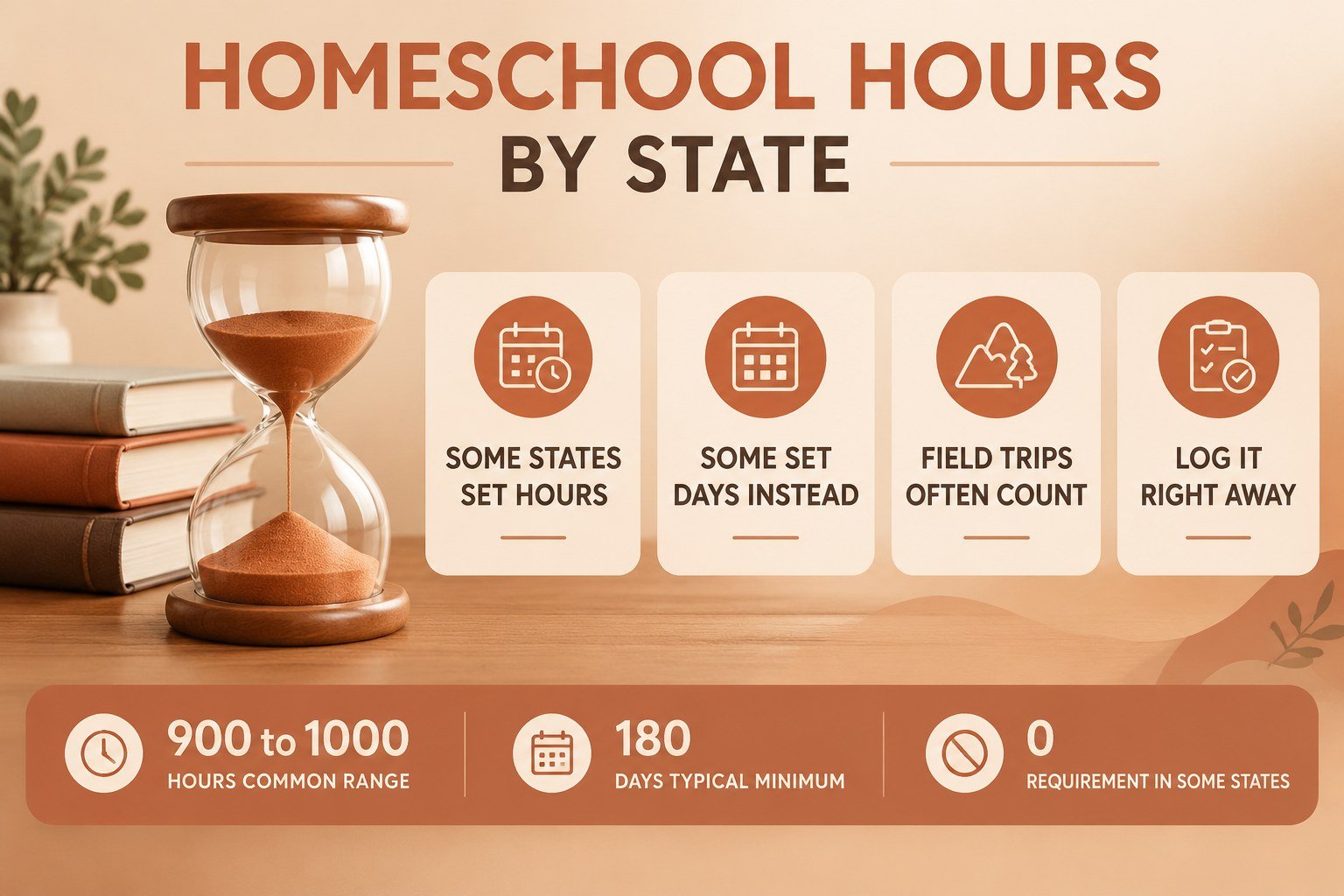
For your state’s exact current requirement, check HSLDA’s state-by-state homeschool law lookup or your state’s department of education. Our own homeschool requirements by state guide covers subjects and testing rules alongside the day and hour side.
How to log the hours
Pick one method and stay with it all year. Switching formats mid-year is how families lose track of the total right when they need it most.
| Method | Best for | Real limit |
|---|---|---|
| Paper log or planner page | Families who want zero screen time to manage this | Easy to lose, harder to total at year end |
| Spreadsheet | Families who want automatic totals by subject | Someone has to build and maintain the formulas |
| A dedicated homeschool app | Families juggling multiple children and grades | Monthly cost, and you depend on the app staying online |
Whatever method you pick, log the date, the subject, and the time spent, right after the lesson ends. Reconstructing hours from memory two months later is where most families undercount. A five-second habit at the end of each subject beats a perfect system you abandon by October.
What if your state sets no hour requirement
Some families still track homeschool hours even where the law does not ask for it. Three reasons show up again and again. A future transcript reads better with real hours behind each credit. A move to a state with a requirement means you already have the habit built. And a rough total gives you an honest read on whether a subject is getting enough time, not just enough days on the calendar.
How many hours a day is realistic
One-on-one instruction covers ground faster than a classroom of twenty five. Most homeschool days land well under a full school day and still meet the year’s required total. Younger grades often run one to two hours of direct instruction plus independent reading and projects. Middle and high school grades run closer to three to four hours of direct work. Electives, reading, and projects fill the rest. Build your homeschool routine around the actual work, not around matching a public school clock.
A steady routine is what keeps an hours log accurate in the first place. If your week keeps sliding and the log keeps falling behind, our homeschool planner builds the weekly structure behind it. Logging homeschool hours becomes a five-minute habit instead of a monthly scramble. Pair it with your homeschool record keeping system. The total then lives next to your other required records, not in a separate notebook you forget to check.
Frequently asked questions
How many homeschool hours do you need?
It depends entirely on your state. Some states set no hour requirement at all, like Texas and Alaska. Others set a specific annual total, such as Ohio’s 900 hours for grades one through six and 1,000 hours for grades seven through twelve. Pennsylvania and Massachusetts combine a day count with an hour range that shifts by grade. Because these numbers change and vary this much, check your own state’s current law directly through your department of education rather than relying on a number you saw for a different state or an old post online. Once you know your target, log homeschool hours by date, subject, and time spent, right after each lesson. The total stays accurate this way, without a big reconstruction project at year end, when memory is least reliable.
Do field trips count toward the total?
Yes, in most states, as long as the trip ties to a real learning goal. A museum visit tied to a history unit, a nature hike tied to a science lesson, or a co-op class all typically count toward homeschool hours the same way textbook time does. What usually does not count is an outing with no educational purpose behind it, like a birthday party or a routine errand. A useful test: could you explain the learning goal of that block if your state ever asked you to? If the answer is yes, log the time the same way you would log a lesson at the table. Keep a short note of the purpose next to the entry in your log, since a bare date and duration will not show the connection to your curriculum months later when you sit down to total the year.
Is homeschool hours the same as homeschool days?
No, and mixing them up is a common mistake. A day-based law counts how many days you provided instruction, regardless of the length of each day. An hour-based law counts total instructional time across the year, regardless of how many days that took. Some states require both, and hitting one does not automatically satisfy the other. Pennsylvania and Ohio both layer hour minimums on top of, or alongside, day expectations, while states like South Carolina lean on days with no hour figure at all. If your state sets an hour requirement, a calendar full of checked-off days will not protect you if your logged homeschool hours fall short of the annual total. Check which type your state uses before you assume one covers the other.
What is the easiest way to track homeschool hours?
The easiest method is the one you will keep using through June, not the most detailed one on paper. A paper log works well if you want zero screen time involved. Totals still take manual math at year end. A spreadsheet gives automatic totals by subject once it is set up, but someone has to build and maintain the formulas as the year goes on. A dedicated homeschool app tracks multiple children and grades at once, at a monthly cost, and depends on the app staying online and supported. Whatever you choose, log the date, subject, and time spent right after each lesson. Trying to reconstruct homeschool hours from memory weeks later is exactly where most families lose real time off their final total, and where a small daily habit pays for itself.
Try the 10-Minute Weekly Reset
Already tried a spreadsheet or an app that didn't stick? This free checklist is built for a week with more than one grade in it — the exact method from the HomeschoolPlanHub system, no card required.
or see every option, free to $49 — See Pricing