How to Build a Homeschool Routine

Try the 10-Minute Weekly Reset
Already tried a spreadsheet or an app that didn't stick? This free checklist is built for a week with more than one grade in it — the exact method from the HomeschoolPlanHub system, no card required.
or see every option, free to $49 — See Pricing
A homeschool routine is the daily pattern that holds your family’s learning life together. It’s not a rigid schedule locked into 30-minute blocks, but a flow that knows what comes next. When you build one, mornings stop being chaotic. Kids know where to start. You know where the bottlenecks will happen before they do.
The difference between families who thrive and those who burn out isn’t talent or willpower. It’s having the right routine that fits your life.
Why your homeschool routine matters more than your schedule
A schedule is a grid. It says “math at 9:15 AM, writing at 10:00 AM.” A routine is the rhythm underneath. It’s the flow of what happens before math, what breaks you take between subjects, what signals to your kids that it’s time to focus.
With a solid rhythm, three things happen:
- Less reminding. Your kids move through the day because they know what comes next, not because you’re calling out instructions.
- Fewer power struggles. The routine becomes “the thing we do,” not something you’re enforcing on them.
- Room for the real world. When a doctor’s appointment bumps your schedule, the routine stays intact. You pick up where you left off.
Predictable daily structure reduces stress for both parents and children. It’s not about control, it’s about clarity. When kids know what comes next, everyone breathes easier. For a wider view of how homeschooling families organize their days, the research on homeschooling is a useful starting point.
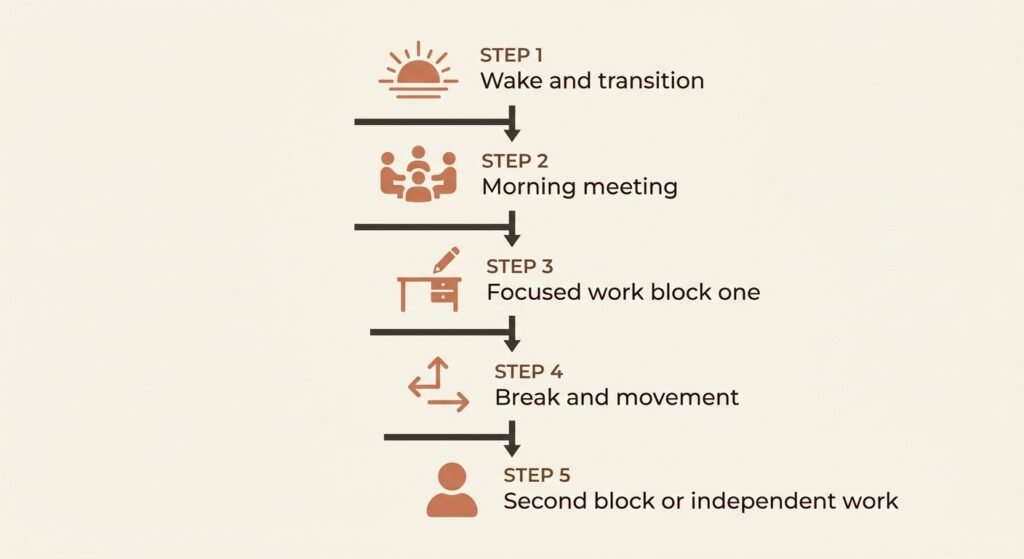
The morning matters most: what a real homeschool routine looks like
If you nail your morning, the rest of the day falls into place. A solid morning routine for homeschoolers typically includes:
Wake and transition (15-30 minutes)
Breakfast, getting dressed, clearing the kitchen together. This isn’t optional busywork. Transitions settle kids’ nervous systems before academics start.
Morning meeting or gathering time (15-30 minutes)
Bible, read-aloud, calendar review, or a family huddle. This anchors the day and makes learning feel like something you do together, not isolation.
Focused work block one (60-90 minutes)
Core academics (math, language arts, or whatever you prioritize). Kids are fresher now. This is where the heavy lifting happens.
Break and movement (15 minutes)
Outside time, stretching, a snack. It breaks the mental fatigue and resets attention.
Second block or independent work (45-60 minutes)
Reading, writing, projects, enrichment subjects. Older kids might start independent work here while younger children get more direct teaching.
This structure shifts by age and season, but the rhythm stays consistent. The rhythm itself is your real homeschool routine.
| Age Band | Ideal Morning Length | Focus Block Structure | Key Difference |
|---|---|---|---|
| Preschool-Kindergarten | About 2 to 3 hours total | Two 20-30 min blocks with breaks | Short attention span, play-based learning |
| Early Elementary (1-3) | About 3 to 4 hours total | Two 45-min blocks with transitions | Can sustain focus, needs movement breaks |
| Upper Elementary (4-6) | About 4 to 5 hours total | Two to three 60-min blocks; can include independent work | Increasing independence, more subjects |
| Middle School (7-8) | About 5 to 6 hours total | Three blocks with clear subject separation | Subject specialists mindset emerging |
| High School (9-12) | 5+ hours total | Four or more blocks; student-directed pacing | Self-management and academic independence |
Loop scheduling vs. grid scheduling for flexible learning
The biggest decision affecting your homeschool routine is whether you use a loop or a grid.
Grid scheduling (also called calendar scheduling) assigns specific subjects to specific days and times. Math on Monday 9 AM. History on Tuesday 10 AM. This works beautifully if your family has external commitments and needs predictability week to week. Many families use a grid-based homeschool routine because it’s easier to explain to outside observers and easier for high school transcript-building.
Loop scheduling (or cyclical scheduling) rotates through your subjects without locking them to specific times. You have a list: math, language arts, history, science, art. You do them in order, and when you reach the end, you loop back. Some days you hit all five subjects. Some days you hit three. Tomorrow you pick up where you left off. This is the rhythm that flexibility lives in.
A loop-based homeschool routine thrives when:
- Your family has unpredictable days (illnesses, appointments, travel).
- You have multiple children at very different levels.
- You’d rather adjust your teaching day based on what’s working than force the day to match a predetermined grid.
- You want your homeschool routine to bend without breaking.
Neither is better. A strong homeschool routine uses whichever system lets your kids learn and keeps you from burning out.
Building your homeschool routine by age and family situation
Preschool and early elementary
Little kids need the most structure because they cannot self-direct yet. But they also have the shortest attention spans. So your routine should be regular (same wake time, same meal times, same start time every day) but flexible in minute-by-minute execution.
A realistic routine for ages 3-6:
- Start at the same time every day (this matters most).
- Keep academic work to 45 minutes total.
- Use movement and play between “lessons” (play-based homeschooling is not less rigorous, it’s developmentally honest).
- Build in a mid-morning snack and outdoor time non-negotiably.
- Expect good work only for the first 30-40 minutes of the day.
Upper elementary (grades 4-6)
Here your structure can expand without becoming overwhelming. Kids can focus for longer stretches. They can follow more complex instructions. They’re developing independence but still need direction.
Your routine might look like:
- Morning meeting: 15-20 minutes (Scripture, read-aloud, calendar, discussion).
- Math: 45-60 minutes (still usually teacher-led or closely supervised).
- Language arts: 45-60 minutes (writing, reading, grammar).
- Independent work or electives: 30-45 minutes (history, science, art, projects they can do with minimal help).
- Afternoon: outdoor time, chores, enrichment, family life.
The key shift: including significant independent work gives you capacity to teach younger siblings or manage other responsibilities.
Middle and high school
Teenagers need autonomy, not less structure. A strong framework at this age means giving them structure and then trusting them to fill it in. They might manage their own schedule within your broader daily rhythm. They choose assignment order. They track their own work.
Your role shifts to accountability and mentoring, not monitoring minutes. Your homeschool routine becomes less about “school time” and more about “learning and growth happen here, structured around our family’s rhythm.”
Multiple grades in one homeschool routine
This is where most homeschooling families live. You’re teaching a 7-year-old and a 13-year-old simultaneously. Your homeschool routine here needs anchor points (times everyone learns together) and parallel work (kids working independently on grade-level material).
A realistic framework:
- Morning meeting (9-9:30 AM): Everyone. Read-aloud, Bible, family time.
- Independent work block (9:30-11 AM): Each child at their own level. You rotate who gets direct teaching.
- Together subject (11-11:30 AM): Science or history you teach at everyone’s level (older child takes more complex notes, younger child participates at their level).
- Lunch and break.
- Afternoon enrichment: Reading, projects, outside time.
See how the routine is the constant? The subjects and pacing bend around it. That’s the real skill: building a homeschool routine that holds even when you’re teaching four different grade levels. (For more, see How to Teach Homeschooling Multiple Grades.)
Building consistency without rigidity
A homeschool routine works because it’s consistent, not because it’s rigid. The difference matters.
Consistency means: we start at 9 AM most days. We do math before read-aloud. Transition happens the same way. Kids can predict what’s coming.
Rigidity means: we start at exactly 9 AM every day or everything falls apart. If math takes two hours instead of one, we can’t adjust. The schedule matters more than learning.
Your homeschool routine needs to be consistent enough to build real habits. It also needs space to be human. You’ll be sick. Kids will have off days. Appointments happen. If your routine breaks when life happens, it’s too fragile.
Tools that help: visual cues and tracking
A well-designed homeschool routine often uses visual aids. Not because kids can’t remember what to do, but because visuals reduce negotiation.
- A daily checklist posted where kids see it. “Morning meeting, then math, then reading, then snack, then independent work.” Kids check items off as they go. (Try The Homeschool Teacher Planner template for this.)
- A visual timer for work blocks. Especially for young kids, seeing time passage is powerful. Twenty minutes left, ten minutes left, time to wrap up.
- A subject tracker if you loop. A simple card that says “Today we’re doing: Math, Language Arts, History, Reading. Tomorrow we’ll do: Science, Art, Writing.”
- Weekly goal board. Not a rigid schedule, but a loose intention: “This week we’ll focus on getting ahead in math and trying a new science experiment.”
When and how to adjust your approach
Review your homeschool routine every 4-6 weeks, not daily. Daily tweaks keep you adjusting and second-guessing. Monthly or quarterly reviews let you see real patterns.
Ask yourself:
- Are kids finishing work by early afternoon most days?
- Is anyone stressed or burned out?
- Are we getting through the material we planned to cover?
- Do mornings feel calm or chaotic?
If the homeschool routine isn’t working, identify what exactly. Not “math time is too long” but “math is taking 90 minutes and kids are frustrated by minute 45.” Then you adjust one piece: maybe split math into two shorter blocks. Maybe start with a warm-up problem. Maybe change the time of day.
Don’t scrap the whole routine because one element isn’t working. Your homeschool routine is your foundation. You adjust the foundation by fixing weak spots, not rebuilding it from scratch every month.
What to do when your approach falls apart
Sometimes your homeschool routine won’t work. A child gets sick for three weeks. You have a new baby. You’re managing a crisis. Real life interrupts.
When your routine breaks, most homeschoolers panic. They think the whole system failed. But your routine didn’t fail. Life just interrupted. There’s a difference.
Signs your routine needs an emergency pause:
- Multiple family members are sick or unusually stressed.
- You have major external demands (new baby, job change, moves).
- Everyone is burnt out and the idea of “trying again tomorrow” feels exhausting.
When any of these hit, don’t “adjust” your routine. Hit pause. Do maintenance mode: read-aloud, maybe one math lesson, that’s it. Let yourself breathe. Your homeschool routine will still be there when you’re ready to restart it.
Signs your routine needs tweaking (not scrapping):
- One time block consistently doesn’t work.
- Kids are resistant to one particular subject.
- You’re getting through the year but it’s unnecessarily stressful.
- Life circumstances changed (new job, new baby, kids grew) and the timing shifted.
In these cases, adjust. Change the time math happens. Split a long block into two shorter ones. Add a snack break. Try loop scheduling if the grid isn’t working.
How your approach changes as kids grow
Your homeschool routine isn’t permanent. What works beautifully for a 6-year-old won’t work for a 12-year-old. A routine that served you perfectly one year might strangle you the next if circumstances change.
Plan to rebuild your routine every few years, usually around major transitions:
- When a child enters middle school or high school.
- When your youngest enters kindergarten and you have more capacity.
- When external activities increase (lessons, sports, community involvement).
- When you add a new child to homeschool or have a new baby.
- When you notice the routine has been creeping into burnout territory.
The goal is a homeschool routine that grows with your family, not one that constrains it. Some families use a seasonal rhythm (light summers, deeper winter learning). Others stay more consistent year-round. Some use weekly planning strategies to stay flexible while maintaining routine.
The point: your homeschool routine is a tool that serves your family, not a law carved in stone. Make it work for you.
Getting started: your first week
If you don’t have a homeschool routine yet, don’t try to design a perfect one. Start simple:
- 1. Pick a start time. Same time every day that’s realistic for your family.
- 2. Decide on your core subjects. What are the non-negotiables? Math and language arts almost always make the list. What else?
- 3. Block out time for each core subject. How long do you realistically have each day? Divide it among your priorities. First draft doesn’t need to be perfect.
- 4. Add breaks and transition time. Don’t schedule every minute. You need breathing room.
- 5. Test it for two weeks. Real feedback beats theoretical planning. What actually works? What doesn’t?
- 6. Adjust once. Make one or two changes based on what you learned. Not ten changes, one or two.
- 7. Commit to it for a month. Give the new homeschool routine time to actually become a routine. Habits take time.
And if you’re struggling to build it alone, use a tool designed exactly for this. Try The 10-Minute Weekly Reset – a free guide that walks you through weekly planning that protects your routine. Use it for a week.
FAQ: Your homeschool routine questions answered
How much structure do I really need in my homeschool routine?
A homeschool routine needs enough structure that kids know what’s coming next and you know where bottlenecks will happen. But it doesn’t need to be rigid hour-by-hour scheduling. Most families find that a basic rhythm (start time, core subjects in order, a break or two, end time) is enough structure to keep things moving without becoming stressful. The structure serves you. If it’s making you miserable, it’s too tight.
What if my kids resist the homeschool routine?
Resistance usually means either the routine is too rigid, the expectations are too high, or a kid is going through a developmental shift. First, ask which. Is the timing genuinely bad? Are they burned out? Are they hitting adolescence and need more autonomy? Then adjust that specific piece. If a 13-year-old resists a routine designed for an 8-year-old, that makes sense. Let them help design their piece of the routine. Autonomy often dissolves resistance faster than enforcement.
Can I use the same homeschool routine all year?
Yes, many families do and it works beautifully. Others shift their routine seasonally (lighter in summer, more academic structure in fall and winter). Some adjust for holidays and testing periods. Pick what fits your family. A consistent routine year-round is easier to maintain because you’re not constantly re-establishing new patterns. A flexible, seasonal routine gives you more breathing room but requires more intentional transitions between seasons.
How long should a homeschool routine actually take each day?
This depends entirely on your children’s ages and your teaching goals. Preschool through second grade typically needs 2-3 hours of formal learning time daily. Elementary through middle school usually runs 3-4 hours. High school can range 4-6 hours depending on course load and rigor. These are active teaching and learning hours, not “school is on the schedule” hours. Younger children need shorter blocks. Older children can sustain longer focus. A realistic homeschool routine builds around attention spans, not wishful thinking about how long your kids can focus.
What’s the single most important element of a homeschool routine?
Starting at the same time every day. Everything else is secondary to this. Same wake time, same breakfast, same start time. This single element creates more momentum and habit formation than any other factor. Once this is locked in, everything else becomes easier to build.
Try the 10-Minute Weekly Reset
Already tried a spreadsheet or an app that didn't stick? This free checklist is built for a week with more than one grade in it — the exact method from the HomeschoolPlanHub system, no card required.
or see every option, free to $49 — See Pricing