How Much Does Homeschooling Cost?
Try the 10-Minute Weekly Reset
Already tried a spreadsheet or an app that didn't stick? This free checklist is built for a week with more than one grade in it — the exact method from the HomeschoolPlanHub system, no card required.
or see every option, free to $49 — See Pricing
If you are pricing out your first year, you want a straight answer. The honest answer to how much does homeschooling cost is a range, not one number. Most families in the United States spend 500 to 2,500 dollars per child each year. A large share land in the tighter band of 700 to 1,800 dollars. The National Home Education Research Institute puts the long-run average near 600 dollars per student. Your own total depends on the curriculum you pick, the classes you join, and how much you buy new.
How much does homeschooling cost per year?
For one child, plan on 500 to 2,500 dollars a year. That covers curriculum, supplies, a few outings, and any testing your state requires. Families who lean on the library and free programs stay under 500 dollars. Families who buy a full boxed curriculum and add outside classes pass 3,000 dollars.
The average sits low because most homeschoolers reuse materials, buy used, and share costs with other families. Grade level nudges the number up as kids get older. The number of children changes your total far less than you would expect. Not sure which method fits yet? Our walkthrough of how to start homeschooling covers the choices that drive the budget.
How much does homeschooling cost at each spending level?
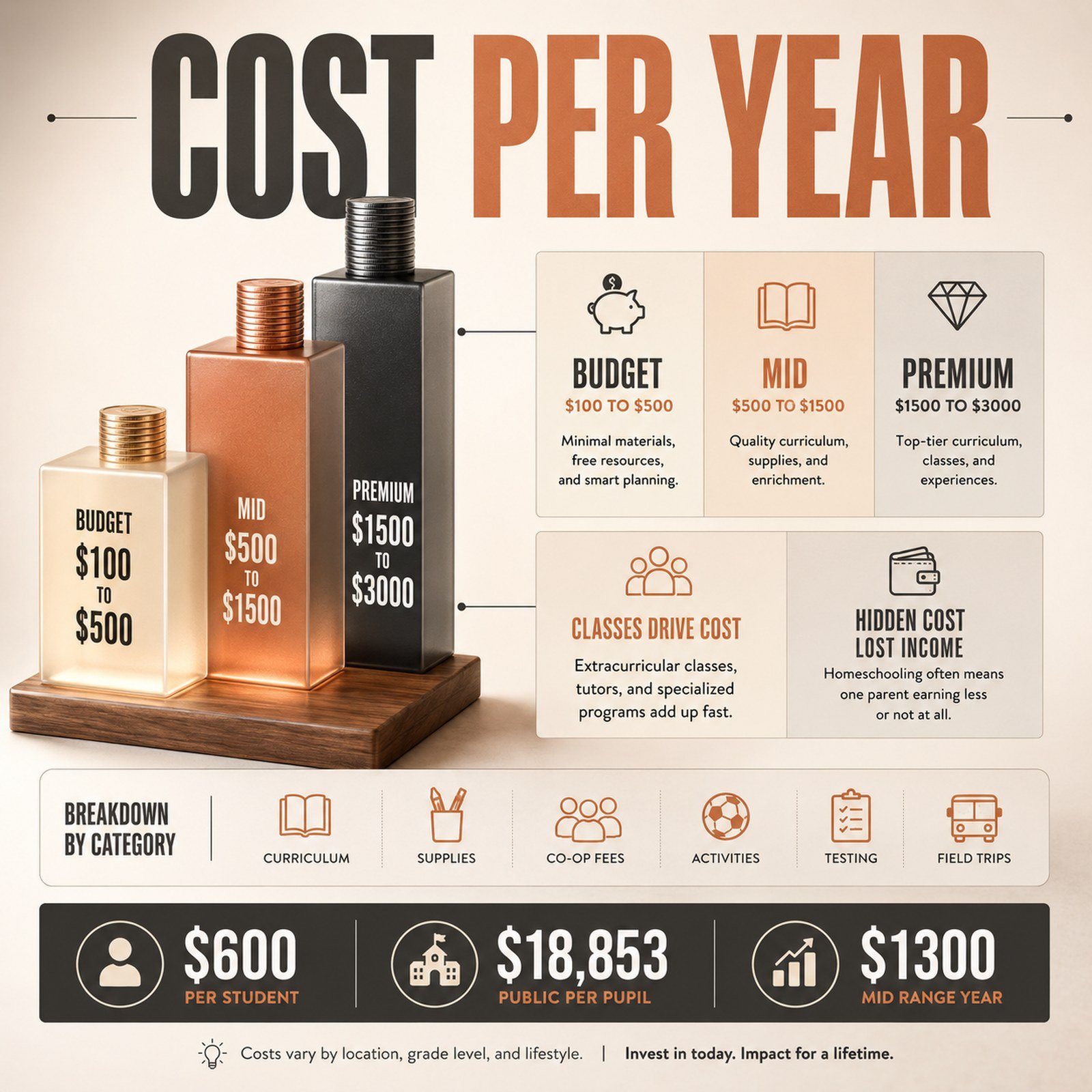
Think in three tiers. A budget year runs about 100 to 500 dollars per child. A mid-range year runs about 500 to 1,500 dollars. A premium year runs 1,500 to 3,000 dollars or more. How much does homeschooling cost at the low end versus the high end mostly depends on how much you outsource, not on the basics.
| Tier | Yearly cost per child | What it usually covers |
|---|---|---|
| Budget | 100 to 500 dollars | Free or open curriculum, library books, secondhand workbooks, paper and ink, one or two low-fee activities |
| Mid range | 500 to 1,500 dollars | One or two paid curriculum programs, a co-op with fees, a standardized test, one sport or music lesson |
| Premium | 1,500 to 3,000 dollars or more | Full boxed curriculum, live online classes, a weekly tutor, lab kits, several paid activities |
Those are list prices. Buying used, sharing a co-op membership, or borrowing read-alouds from the library can drop any tier by a third.
Budget: 100 to 500 dollars per child
A budget year works when the public library is your main supplier and your curriculum is free. Open-and-go programs such as Easy Peasy All-in-One and Khan Academy cost nothing to use. Secondhand curriculum groups and buy-nothing pages fill in the rest. Your real spending is printer paper, ink, and a few basic supplies.
Mid range: 500 to 1,500 dollars per child
Most families land here. A common mix is one paid math program, one paid language arts program, and library or free resources for everything else. On top of that goes a co-op at 100 to 400 dollars a term, one sport or music lesson, and a standardized test where the state asks for one.
Premium: 1,500 to 3,000 dollars or more
A premium year usually means a full boxed curriculum at 400 to 1,000 dollars per child. Add one or two live online classes at 200 to 600 dollars each. A weekly tutor runs 30 to 80 dollars an hour. Lab kits, art supplies, and several paid activities push the total higher.
Where does the money go when you homeschool?
Six categories cover almost every homeschool receipt. They are curriculum, consumables and supplies, co-op or class fees, extracurriculars, testing or evaluation, and field trips. Technology and printing run underneath all of them. Curriculum and outside classes drive most of the difference from one family to the next.
| Category | Typical yearly range per child | Notes |
|---|---|---|
| Core curriculum | 0 to 900 dollars | Free open programs at the low end, boxed sets at the high end |
| Consumables and supplies | 50 to 300 dollars | Workbooks, paper, ink, art materials, basic science gear |
| Co-op or class fees | 0 to 1,200 dollars | Charged per term or per year, often with a materials fee added |
| Extracurriculars | 0 to 1,500 dollars | Sports leagues, music lessons, dance, scouting, clubs |
| Testing or evaluation | 0 to 200 dollars | Only where your state asks for it |
| Field trips | 50 to 400 dollars | Museum passes, parking, travel, group tours |
Curriculum and books
Curriculum is the biggest single lever on how much does homeschooling cost, and it is the easiest to control. A full boxed set runs up to 900 dollars per child. A free open program runs nothing. The used market usually cuts 40 to 60 percent off retail, and non-consumable books work again for the next child.
Supplies, co-op fees, and testing
Basic supplies run 50 to 300 dollars a year: paper, ink, notebooks, art materials, and simple science gear. Co-op fees range from nothing to 1,200 dollars, depending on how many classes you take. Testing depends on your state. Check what your state requires before you budget for a test or an evaluator.
Extracurriculars and field trips
Activities are the sneaky line. One travel sports team or a serious music track can cost more in a year than a full curriculum. Field trips run 50 to 400 dollars a year for passes, parking, and group tours. These are family choices, not a fixed price of homeschooling.
How much does homeschooling cost for high school?
High school runs higher, usually 1,300 to 1,800 dollars a year against roughly 1,300 for the early grades. Family surveys put the average near 1,300 dollars for an elementary student and 1,600 dollars for a middle or high schooler. This is the stretch where how much does homeschooling cost climbs the most as a child ages.
The extra money goes to several places. Lab sciences need kits, and higher-level math costs more. You also pay for outside classes, dual enrollment fees, and entrance tests. Transcripts and record-keeping you can do yourself for free.
How much does homeschooling cost for multiple kids?
The second child almost never doubles the bill. Non-consumable curriculum, books, and equipment carry over from one child to the next. Plan on the full amount for your oldest, then 40 to 60 percent of that for each younger sibling.
What you re-buy is consumables: workbooks, lab materials, and anything a child writes in. Per-child activity and co-op fees also repeat. Teaching history, science, art, and read-alouds to several kids at once keeps the shared portion large. The per-child cost stays low.
How much does homeschooling cost if you want it free?
If your goal is free, expect to pay about the price of paper and ink. That is roughly 50 to 150 dollars, with an open-and-go free curriculum and a library card. Easy Peasy All-in-One, Khan Academy, Ambleside Online, and many state virtual programs charge nothing.
Add museum reciprocal passes, 4-H, and public park programs for low-cost enrichment. The trade-off is your time, since free curricula need more planning and printing than a boxed set that arrives scheduled. Our roundup of homeschool discounts and freebies lists current deals and free downloads by subject.
What hidden costs does homeschooling add?
The sticker price is only part of how much does homeschooling cost in practice. The costs that surprise families are lost income, curriculum that does not work out, and small recurring extras. Lost income is by far the largest.
Lost income is the biggest one
When one parent leaves a job or cuts hours to teach, that missing paycheck usually dwarfs every curriculum receipt combined. A part-time role at 20 hours a week and 20 dollars an hour comes to about 20,000 dollars a year. A full-time 45,000-dollar salary is worth more than a decade of premium curriculum.
Families offset this with split shifts, evening or weekend work, freelance income, or a lower cost of living. Many parents keep a paycheck coming in by homeschooling while working full time.
Small extras that add up
Printer ink and paper run 60 to 200 dollars a year if you print your own worksheets. Gas for co-op and field trips adds up over a semester. Most families also buy at least one curriculum that does not fit and gets shelved by October, so budget one miss. Grocery and utility bills rise a little with everyone home all day.
How much does homeschooling cost vs public and private school?
Out of pocket, homeschooling is far cheaper than private school. It is often cheaper than the fee-and-supply bill at a public school too. On paper, how much does homeschooling cost stays well below both. The catch is that families pay their share directly, and many give up an income to do it.
Taxpayers spend about 18,853 dollars per pupil a year on public school. Private school tuition averages around 12,350 dollars. Homeschool families spend 500 to 2,500 dollars per child. Add lost wages, though, and the real gap narrows for single-income households.
| Option | Direct cost to the family per year | Who covers the rest |
|---|---|---|
| Public school | 0 to 1,000 dollars in fees and supplies | Taxpayers, about 18,853 dollars per pupil |
| Private school | 12,000 dollars or more in tuition | The family |
| Homeschool | 500 to 2,500 dollars per child | The family, plus any income given up |
How much does homeschooling cost after grants and tax breaks?
For most families, the answer does not change. There is no federal homeschool tax deduction, and most states offer none either. A growing number of states now fund education savings accounts or scholarships. Homeschoolers can put these toward curriculum, classes, and tutoring.
A handful of states, including Arizona, Florida, and Iowa, run education savings account programs. A few others, such as Illinois, Louisiana, and Minnesota, allow a small education expense deduction or credit. It can include homeschool materials. Some co-ops and curriculum publishers also offer need-based scholarships and hardship pricing.
How to spend less on homeschooling
You have more say over the total than any curriculum company does. A few habits keep a year affordable without cutting quality.
- Start with one paid subject at most, and fill the rest with free programs.
- Buy used, since swap groups sell last year’s curriculum at 40 to 60 percent off.
- Choose non-consumable books you can reuse with younger siblings.
- Borrow read-alouds and living books from the library instead of buying them.
- Share a co-op ride and split materials fees with another family.
- Print in draft mode, and only the pages you will actually use.
- Pick one paid activity per child each season rather than three.
- Wait for spring and end-of-year curriculum sales before buying.
- Keep a curriculum tracker so you never re-buy a book you already own.
Knowing how much does homeschooling cost only helps if you plan against it. Our two free homeschool planning printables and full pricing options help here. You can lay out subjects, activities, and a rough budget in one sitting, then buy once instead of three times.
Frequently asked questions
How much does homeschooling cost?
For one child in the United States, homeschooling usually costs 500 to 2,500 dollars a year for curriculum, supplies, testing, and outings. Most families land between 700 and 1,800 dollars, and the National Home Education Research Institute puts the long-run average near 600 dollars per student. Your number depends on three choices. They are your curriculum, your outside classes and co-ops, and how many paid activities each child does. A budget year can stay under 500 dollars with the library and open curriculum. A premium year with live online classes and a weekly tutor can pass 3,000 dollars. High school runs a few hundred dollars higher than the early grades because of lab sciences, outside classes, and college testing. The largest cost is usually not on any receipt: it is the income a parent gives up to teach.
Can you homeschool for free?
Close to free, yes. A full year with a free open-and-go curriculum such as Easy Peasy or Khan Academy costs almost nothing. With a library card, expect 50 to 150 dollars for paper and printer ink. Ambleside Online, Blossom and Root’s free tier, and many state virtual programs also cost nothing to use. Museum reciprocal passes, 4-H, and public park programs add low-cost enrichment. The trade-off is your time, since free curricula usually need more planning and printing than a boxed set that arrives scheduled. You will still pay for consumables, like workbooks you cannot legally copy. Activities with their own fees, like a sports league or music lessons, also cost extra. Testing, where a state requires it, runs 25 to 75 dollars. Many families run a free core and spend only on the one or two things that matter most to them.
Why does homeschooling cost more for some families?
The spread comes almost entirely from outside classes and activities, not from the basics. Curriculum can cost nothing, or it can cost 900 dollars per child for a full boxed set. On top of that, a co-op runs 100 to 400 dollars a term. A live online course runs 200 to 600 dollars. A private tutor runs 30 to 80 dollars an hour. A child in travel sports or serious music lessons can cost more in a year than the entire curriculum. High school adds lab kits, higher math, dual enrollment fees, and college testing. Families with several children spend more in total but far less per child, because non-consumable books and equipment carry over. Location matters only a little. A few states require a paid test or a certified evaluator, which adds 50 to 200 dollars a year.
How much does homeschooling cost for one child per year?
Plan on 500 to 2,500 dollars a year for one child, with most single-child budgets landing near 700 to 1,800 dollars. A realistic mid-range year looks like this: 300 dollars for one or two paid curriculum subjects, 150 dollars for workbooks and supplies, 250 dollars for a co-op term, 400 dollars for one activity, 50 dollars for testing, and 150 dollars for field trips and printing. That comes to about 1,300 dollars. Trim it toward 500 dollars by using free curriculum and skipping the co-op. Push it past 2,500 dollars by adding live online classes and a weekly tutor. High school sits a few hundred dollars higher because of lab sciences and college testing. Remember to add printer ink and the odd curriculum that does not work out, which together run 100 to 250 dollars for most families.
Try the 10-Minute Weekly Reset
Already tried a spreadsheet or an app that didn't stick? This free checklist is built for a week with more than one grade in it — the exact method from the HomeschoolPlanHub system, no card required.
or see every option, free to $49 — See Pricing