Homeschool Supply List: What to Buy?
Try the 10-Minute Weekly Reset
Already tried a spreadsheet or an app that didn't stick? This free checklist is built for a week with more than one grade in it — the exact method from the HomeschoolPlanHub system, no card required.
or see every option, free to $49 — See Pricing
A homeschool supply list looks simple until you are standing in a store aisle with a full cart and no idea what you will use by October. Most lists online run long because they are selling something. The real starter list is short. You need writing tools, paper, and a way to print. Add a few math items you can hold, a place to keep records, and somewhere to put it all. This guide sorts the buy-now items from the ones you can borrow, skip, or add later. It gives a rough cost for each.
What do you need on a homeschool supply list to start?
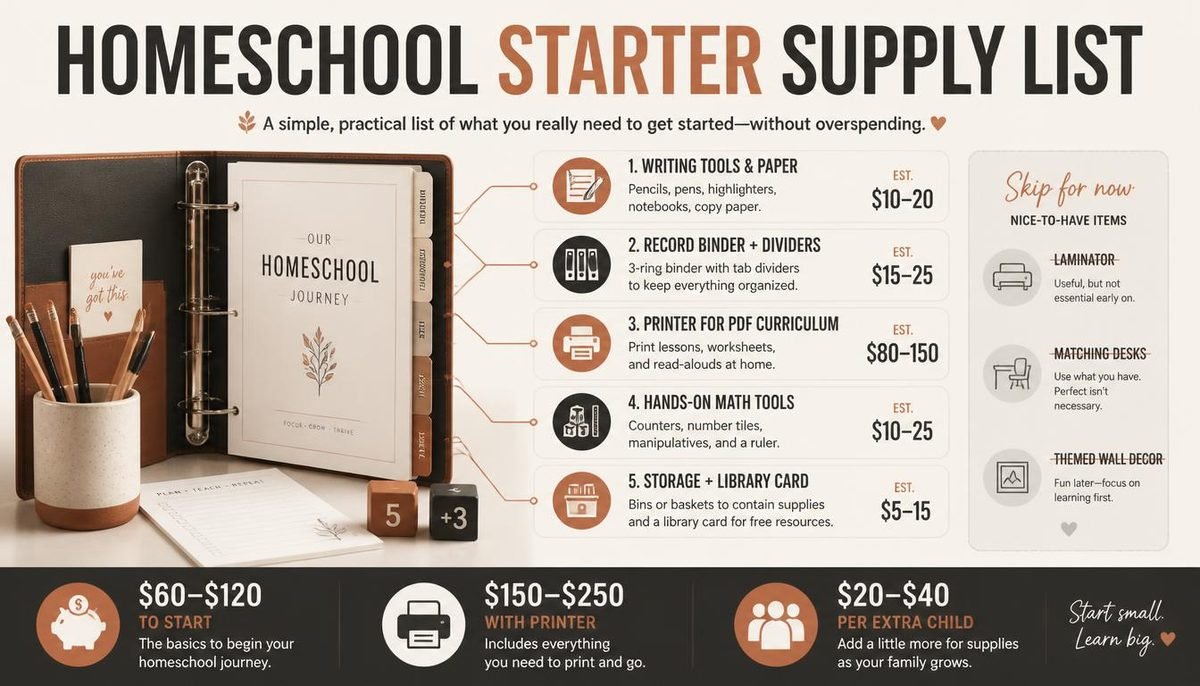
Start with six categories, not sixty items. A working homeschool supply list covers writing and paper, printing, hands-on math, reading material, record storage, and a daily calendar. Everything else is optional for the first term. If you buy only those six groups, you can teach any grade on day one. The rest can wait until a real gap shows up in your week.
The core homeschool supply list: what to buy now
These are the items you will use every week, in any subject, at any grade. Buy the core homeschool supply list first. Then stop and see what your lessons really ask for before spending more.
| Category | What to get | Rough cost, one child | Why it stays on the list |
|---|---|---|---|
| Writing and paper | Pencils, erasers, lined and blank paper, one pack of colored pencils | $15 to $25 | Used in every subject, every day |
| Record binder | One 2 inch binder, dividers, sheet protectors | $10 to $15 | Holds the attendance, samples, and logs your state may ask for |
| Printing | Inkjet printer, spare ink, one ream of paper | $0 to $120 | Most free and paid curriculum arrives as PDF pages |
| Hands-on math | Counters, base ten blocks or a bag of coins, a ruler, a basic calculator | $15 to $30 | Young children need to touch math before they write it |
| Reading material | Library card, a shelf for read-alouds and reference books | $0 | A library card replaces most of a book budget |
| Storage | Two bins or a cart, one folder per child for current work | $15 to $40 | Loose paper is the first thing to bury a new homeschool |
| Daily calendar | Wall calendar or a simple planner page | $0 to $20 | You need dated records even with a flexible schedule |
If you are still deciding whether to teach at home at all, the printer can wait. A library and a phone camera cover printing for a few weeks. For setup help, see how to start homeschooling for the step order, and set up a homeschool space without a spare room for low cost storage ideas.
What to skip or borrow before you overspend
The fastest way to waste money on a homeschool supply list is to recreate a classroom. You do not teach thirty children. You do not need classroom furniture, a laminator, bulletin board sets, or a workbook for every subject. Borrow or delay these until a lesson clearly needs them.
- Laminator and thermal pouches. A page protector does the same job for a few cents.
- Matching desks and a teacher chair. Kitchen table learning is normal and works.
- Themed wall decor and letter borders. They fade into the background within a week.
- A full craft cabinet. Buy craft items per project, not in bulk.
- Workbooks for subjects you have not started. Wait until the curriculum names them.
- A second device for each young child. One shared computer covers early grades.
A library card, a borrowed reading assessment, and free printable pages cover more than most starter kits. See homeschool discounts and freebies for where families find those pages and store deals.
Supplies your state record rules quietly require
Some items on a homeschool supply list are there because of the law, not the lessons. Many states ask you to keep attendance, work samples, a reading list, or a portfolio. That means you need a place to store paper from week one, not a scramble in May.
Check your own state first. HSLDA’s homeschool laws by state lists what each state asks families to keep. Then build the storage to match it. Use a binder with dividers for logs, sheet protectors for graded samples, and one folder per child per year. Our guide to homeschool record keeping covers how long to hold each type.
How a homeschool supply list changes by grade
The core list stays steady. What moves is the edge of the homeschool supply list. A kindergarten kit leans on manipulatives and large pencils. A high school kit adds lab and testing tools and drops the hands-on math.
| Grade band | Add to the list | Take off the list |
|---|---|---|
| PreK to K | Fat pencils, counting bears, a dry erase board, safety scissors | Binder can be one thin folder |
| Grades 1 to 3 | Handwriting paper, flash cards, a clock with hands | Counting bears once numbers are solid |
| Grades 4 to 6 | Compass and protractor, atlas or globe, index cards | Fat pencils, most manipulatives |
| Grades 7 to 8 | Scientific calculator, lab notebook, citation guide | Flash cards, handwriting paper |
| Grades 9 to 12 | Graphing calculator, lab kit, transcript and credit binder | Dry erase practice, elementary readers |
Buy the grade add-ons in the month you reach them, not in advance. A graphing calculator bought in grade six sits in a drawer for three years.
One list or one per child?
Most of a homeschool supply list is shared. One printer, one set of math blocks, one art bin, and one reference shelf serve the whole family. Only a few things need to be per child.
Give each child a pencil box, a current work folder, headphones for screen lessons, and their own record binder. Everything else lives in a common spot. Families teaching several ages at once can go deeper in homeschooling multiple grades, which covers shared materials and staggered schedules.
What the first-month homeschool supply list really costs
A first-month homeschool supply list runs about $60 to $120 if you already own a printer and use the library. Expect $150 to $250 if you buy a printer and a few grade add-ons at once. Curriculum is a separate line and is usually the larger cost.
You can lower the number. Free printable planner and log pages cover the paper side, and many stores honor a homeschool discount. Maybe you would rather buy only the pages you need. Our individual homeschool planner and log templates let you pick attendance, portfolio, or lesson pages one at a time, not as a full bundle.
A starter homeschool supply list you can copy
Most sites hide their checklist behind an email form. Here is the whole thing. This starter homeschool supply list covers one child for the first term. Add a second copy of the personal items for each extra child.
- Two dozen pencils, three erasers, one handheld sharpener
- One ream of lined paper, one ream of blank paper, one pack of colored pencils
- One 2 inch binder, one set of 8 dividers, 20 sheet protectors
- One pack of index cards, one roll of tape, one pair of scissors
- Counters or coins, base ten blocks, a 12 inch ruler, a basic calculator
- Two storage bins and one plastic folder per child
- A wall calendar or one printed planner page per week
- A library card for every family member
Everything past this point is a response to a real lesson, not a guess. Wait for the curriculum, the grade, or the state form to tell you what else the list needs.
Frequently asked questions
What do you need to buy from a homeschool supply list?
Buy six groups first: writing tools and paper, a record binder, a way to print, hands-on math items, storage bins, and a dated calendar. That set lets you teach any grade on the first day. Pencils, erasers, lined paper, and blank paper get used in every subject, so buy those in bulk. A 2 inch binder with dividers and sheet protectors holds the attendance, samples, and logs many states ask for. A cheap inkjet printer matters because most free and paid curriculum arrives as PDF pages. Young children need counters, base ten blocks, and a ruler to see math before they write it. Two bins and one work folder per child keep loose paper from taking over. Skip the laminator, classroom desks, and subject workbooks you have not started. Add those only when a specific lesson calls for them.
Do you need a printer to homeschool?
You do not need a printer to start, but you will want one within a month if you use printable curriculum. Most free and paid homeschool programs deliver worksheets, schedules, and record pages as PDF files. For the first few weeks you can read lessons on a screen, copy problems into a notebook, or photograph a page and print it at the library. That works for early grades and for testing whether homeschooling fits your family. Once lessons settle, a basic inkjet printer with spare ink saves hours of copying. It also lets you reprint a page when a child needs another try. Buy a plain model, keep an extra ink set, and stock one ream of paper. A laser printer costs less per page if you print heavily. The higher upfront price is still hard to justify in a first year.
How much should a homeschool supply list cost for the first year?
Plan on $60 to $120 for supplies alone if you already own a printer and use your library for books. That covers pencils, paper, a binder, basic math manipulatives, storage bins, and a wall calendar. If you add a printer, ink, and one or two grade specific tools, the number moves to $150 to $250. A second child usually adds only $20 to $40, since most items are shared across the family. Curriculum is a separate line and is usually the bigger expense. It ranges from near zero with free programs to several hundred dollars per child for a boxed set. You can hold the supply number down. Borrow books, reuse bins you own, print free planner pages, and ask whether local stores give a homeschool discount. Buy grade add-ons in the month you reach them, not all at once. Tools bought years early often sit unused.
What homeschool supplies are a waste of money?
The common regrets are items that copy a classroom you do not run. A laminator and thermal pouches top the list, because a reusable page protector does the same job for pennies. Matching student desks and a teacher chair rarely get used once a family drifts back to the kitchen table. Themed wall borders, letter sets, and bulletin board kits stop being noticed within a week. A stocked craft cabinet tends to dry out before it is used up, so buy craft materials per project instead. Workbooks for subjects you have not started can become clutter if the curriculum you pick later does not match them. A second computer for each young child is usually unnecessary, since one shared device covers early grades. Spend that money on books, a printer, or a co-op class instead.
Try the 10-Minute Weekly Reset
Already tried a spreadsheet or an app that didn't stick? This free checklist is built for a week with more than one grade in it — the exact method from the HomeschoolPlanHub system, no card required.
or see every option, free to $49 — See Pricing