What Is a Homeschool Co-op?

Try the 10-Minute Weekly Reset
Already tried a spreadsheet or an app that didn't stick? This free checklist is built for a week with more than one grade in it — the exact method from the HomeschoolPlanHub system, no card required.
or see every option, free to $49 — See Pricing
A homeschool co-op is a small group of homeschooling families. They meet on a set day to teach and support each other’s kids together. Instead of every parent building every subject alone at the kitchen table, the group splits the work. One parent leads art. Another runs science experiments. Another organizes the field trip calendar. If you have been asking what is a homeschool co-op, here is the short answer: you trade some independence for community, shared teaching, and a weekly rhythm your kids start looking forward to.
Co-ops range widely in size. Some are four families rotating lessons in a living room. Others are a hundred families renting a church building with hired teachers and a full class schedule. None of that range is random. It comes down to three real decisions every co-op makes. Who does the teaching? What philosophy does it follow? Do parents stay on site? This guide walks through all three, including what is a homeschool co-op going to cost, the honest trade-offs, and how to vet a group before you commit a weekday to it.
What is a homeschool co-op?
A homeschool co-op, short for cooperative, is a group of homeschooling families. They pool their time, skills, and sometimes money to teach their kids together on a set day each week. It is not a school. No one issues grades or a diploma. Most groups meet only once or twice a week. Families still handle most of their teaching at home. The co-op adds classes, group projects, and the kind of regular social time a homeschooled child needs that one household cannot easily provide alone.
The model works because teaching gets specialized instead of duplicated. A parent who is strong at writing leads a writing class. A parent who used to work in a lab runs the science block. A parent who plays piano teaches music. In exchange, every family contributes something: teaching, assisting, driving, or a modest fee. That fee usually covers space rental and shared supplies. Most co-ops run on a school-year calendar. A fall term and a spring term mirror the rhythm of a normal academic year.
A co-op is not a legal school, and it does not report to any state agency. Its structure varies a lot from one group to the next. What is a homeschool co-op on paper rarely matches what it becomes once real families start running it. A co-op sits below an umbrella school or a hybrid program in formality, and it rarely issues an official transcript or credit on its own. That difference matters later, once a family starts building a high school record. It is one reason most co-ops recommend families keep their own attendance and work samples at home too. What is a homeschool co-op once you move past the definition? Mostly a support structure, not a substitute for the work happening at home.
What is a homeschool co-op’s typical structure and schedule?
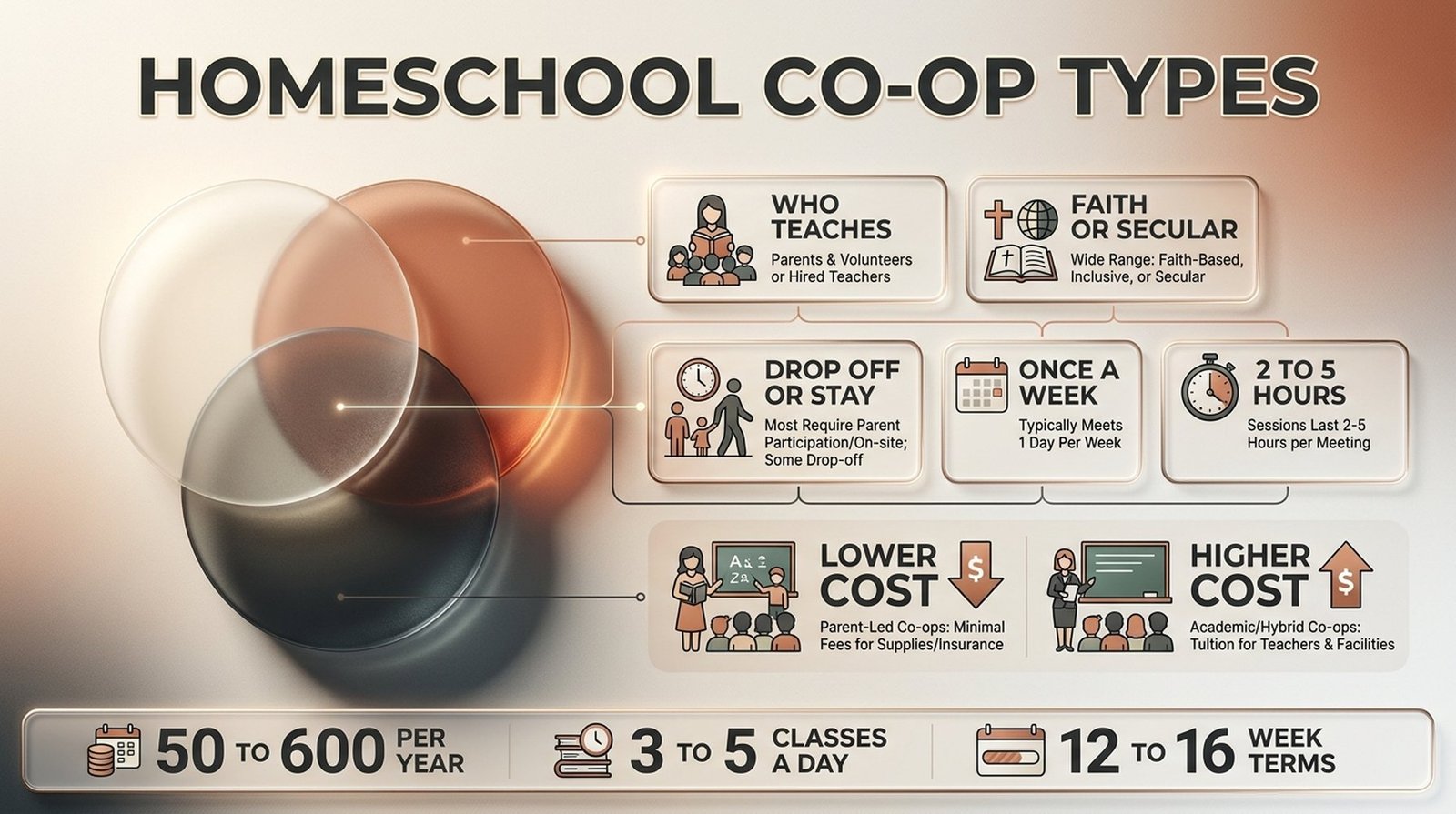
Most homeschool co-ops meet once a week for two to five hours. They run during the traditional school year, on a term system similar to a semester. A typical day includes three to five back-to-back classes, each lasting thirty to sixty minutes. Families arrive mid-morning and head home by early afternoon.
A normal co-op day starts with drop-off or a group check-in. Kids rotate through classes by age group. Most groups break for a shared lunch or recess, then wrap up with pickup. Class size usually runs between six and twenty kids per room. Rooms are split by grade band, not exact grade, since most co-ops do not have enough kids at any single grade level to fill a room alone.
Once the basic shape is set, what is a homeschool co-op’s schedule really comes down to two variables: weekly hours, and weeks per term. Terms usually run twelve to sixteen weeks. A fall term ends before winter break, and a spring term picks back up in January. Some co-ops meet every other week instead of weekly. Larger groups sometimes add a second day for older students. Group size varies just as much, from four families around a dining table to a hundred families running a full building.
Many co-ops require a term-long commitment, not drop-in attendance. A teacher planning a semester of lessons needs to know who is showing up each week. Missing more than a class or two without notice can cost a family its spot the next term. That risk is highest in small parent-teach groups, where one missing family changes the whole lesson plan. What is a homeschool co-op really asking of a family before the first class even starts? A term-long commitment, not a casual drop-in.
What is a homeschool co-op going to cost you?
A homeschool co-op usually costs between $50 and $600 per child for a full school year. Co-ops that hire outside teachers can run well past $1,000. The number depends almost entirely on who is teaching. Parent-taught groups mostly charge a small facility and supply fee. Groups built around paid instructors charge something closer to real tuition.
That fee usually covers building rental and basic supplies. Some groups add liability insurance for the whole co-op. Hired-teacher and drop-off co-ops add cost on top of that. A paid instructor for a science lab or a foreign language class typically charges per student, per class, per term. A family taking three hired classes pays three separate fees, not one.
Costs beyond the sticker price add up fast. A registration deposit is often due before the term starts. Many groups charge a background check fee for any parent who wants to teach or volunteer. Curriculum or kit purchases for classes like art or science are usually separate too. Multi-child families often get a break, sometimes a flat family rate instead of a per-child charge, so it is worth asking before you assume the cost scales in a straight line. In the end, what is a homeschool co-op going to cost comes down to one variable: whether the teachers are paid or volunteer.
Co-op fees are just one line inside how much does homeschooling cost across a full year. Families working with a tight budget often layer in homeschool discounts and freebies to offset a co-op term instead of cutting it entirely.
What is a homeschool co-op parent teaching duty really like?
Most parent-teach co-ops expect every family to contribute. That might mean teaching a class, assisting another teacher, or handling a non-teaching job like registration, snack duty, or cleanup. Hired-teacher and drop-off co-ops are the exception. They run on paid staff, so parents pay more but owe no teaching slot.
Duty systems vary, but one job per family per term is common. Many groups track it with a simple point system or a signup sheet at the first meeting. What is a homeschool co-op parent duty, honestly? Expect one job, not a symbolic one. A first-time teaching parent is usually steered toward something they already do at home. A parent who reads aloud every night leads a book club. A parent who bakes leads a cooking elective. A parent who coaches a rec team runs PE.
Backup coverage matters more than most new families expect. A teaching parent who gets sick is generally expected to find their own substitute or trade weeks with another teacher, not simply cancel class. For families already juggling homeschooling multiple grades at home, this duty load is often the real dealbreaker, not the fee. Ask exactly what job you would be assigned before you sign up, not after. What is a homeschool co-op really like once the fee is paid? For most first-time members, the duty assignment changes more than the tuition does.
What is a homeschool co-op’s range of types?
Homeschool co-ops split along three separate lines. Who does the teaching? What philosophy or faith background does the group hold? Do parents stay on site during class hours? A single group can land anywhere on all three. So what is a homeschool co-op, really? The honest answer depends on where a specific group falls on each one.
Academic and enrichment co-ops versus parent-teach co-ops
An academic co-op focuses on core subjects: math, writing, science. Some aim for genuine rigor, built for high schoolers who want a class that looks like a transcript entry. An enrichment co-op leans lighter: art, foreign language, PE, drama, book club. These are the subjects hardest to run solo at home, but not the core of a family’s curriculum.
Layered on top of that split is who ends up teaching. A parent-teach co-op runs entirely on member parents rotating subjects. That keeps cost low, but class quality depends on who happens to be in the group that year. A hired-teacher co-op pays outside instructors instead. That raises the cost, but it removes the teaching duty. It also raises the ceiling on subjects like a full lab science or a language taught by a fluent speaker.
Secular co-ops versus faith-based co-ops
Faith-based co-ops are the most common type nationally, and many started inside a specific church or denomination. Joining one usually means signing a statement of faith. The day itself may open with prayer or include a Bible class alongside academics.
Secular co-ops exist too, especially in larger metro areas. They deliberately keep religious content out of the classroom entirely. Neither model is better. But the mismatch between the two is one of the most common regrets families report after joining the wrong one. Confirm this up front rather than assuming.
Drop-off co-ops versus parent-participation co-ops
A drop-off co-op lets parents leave for the day, since hired teachers or trained staff supervise every room. It functions closest to a part-time school and costs more. In exchange, parents get hours back to work, run errands, or teach a younger child at home.
A parent-participation co-op asks for the opposite. Every parent stays on site the whole time. Some help run a room. Others supervise a hallway or cover a duty shift. It costs less, and it tends to build closer relationships between parents, since everyone is there together every week, not just dropping off kids.
| Co-op type | Who teaches | Typical yearly cost per child | Weekly time commitment |
|---|---|---|---|
| Parent-teach academic | Member parents, rotating subjects | $50 to $200 | One class day, plus a teaching slot and prep time |
| Hired-teacher academic | Paid outside instructors | $300 to $900 per class | One class day, no teaching required |
| Enrichment-only | Parents and a few paid specialists | $100 to $400 | A few hours, one day a week |
| Faith-based | Almost always parent-taught | $50 to $250 | One class day, plus a statement of faith |
| Secular | Parent-taught or hired, no religious content | $75 to $500 | One class day |
| Drop-off | Hired teachers or trained staff | $400 to $1,200 | One class day, parents are free during hours |
| Parent-participation | Member parents | $50 to $300 | One class day, parent stays on site to help |
What is a homeschool co-op’s real pros and cons?
The real upside of a homeschool co-op is consistent social time and shared teaching load. It also opens up subjects one parent cannot easily run alone, like a full lab class or a language taught by a native speaker. The real downside is a fixed weekly commitment, an added cost, and dependence on other families showing up prepared. Neither list is universal. What is a homeschool co-op worth, on balance? That depends heavily on which type from the section above you join.
The benefits families report most often
Across parent-teach, hired-teacher, faith-based, and secular groups alike, a few upsides come up again and again:
- A consistent peer group the same age, every week, without arranging playdates
- Subjects one parent cannot easily run alone: lab science, a second language, team sports
- A concrete deadline and outside accountability for a project-based class
- Built-in relief on a drop-off day, or shared duty instead of solo teaching
- Group buying power for field trips, testing, and bulk supplies
- A ready-made curriculum swap and resource network with other parents
- An easier transition for a kid used to a classroom setting
The real trade-offs and downsides
The same structure that makes a co-op useful also creates its costs. Most of them only show up after the first term, once the novelty of the new schedule wears off:
- A fixed weekly time slot, which cuts against the flexibility that draws many families to homeschooling in the first place
- Class quality that depends on whoever happens to be teaching that term, not a vetted curriculum
- Personality conflicts and group politics, the same as any volunteer organization
- Extra driving time, sometimes across town, on top of the class hours themselves
- A cost that adds up fast once more than one child is enrolled in hired classes
- A term-long commitment even after a class turns out to be a poor fit
- For a family already stretched thin, a mandatory teaching slot can add to homeschool burnout instead of relieving it
How do you find and vet a homeschool co-op near you?
The fastest way to find a real homeschool co-op is to ask local homeschooling families directly. Most groups fill by word of mouth or a private group chat before they ever post publicly. A searchable public directory, like the one HSLDA maintains, is the next best starting point if you do not know any local families yet. What is a homeschool co-op you can join this term? Either path gets you there.
Where to start looking first
HSLDA’s homeschool groups directory lists co-ops, support groups, and enrichment programs searchable by state. It is a solid first stop if you do not already know local families. Beyond that, a few places tend to work just as well: a local support group’s Facebook page, a state or regional homeschool association’s group list, a library bulletin board, or a curriculum fair or park day. Most co-ops fill up through these channels, often before a public listing ever exists.
If you are still working out how to start homeschooling in the first place, treat a co-op as a step-two decision. Get a home rhythm running first. Then figure out what is a homeschool co-op you genuinely want: parent-teach or hired, faith-based or secular, drop-off or parent-participation. Knowing that before you start looking saves a lot of wasted visits.
A short vetting checklist before you sign up
A short conversation before you commit saves most of the regret families report after joining the wrong co-op. Ask about cost, duty expectations, philosophy, and group size before your first visit, not after.
| Question to ask | Why it matters |
|---|---|
| What is the total cost, and what does it cover? | Base fees rarely include hired-class tuition, supply kits, or a registration deposit |
| Is there a required teaching or volunteer job? | Determines your actual weekly time cost, not just the class hours |
| Is the group faith-based or secular? | Avoids an awkward mismatch mid-term over prayer or a Bible class |
| Is it drop-off or parent-participation? | Changes whether you get the day back or stay on site the whole time |
| What happens if we miss a class or a term? | Some groups drop a family’s spot after missed weeks with no notice |
| How many families and kids are in our child’s age band? | A room of three kids plays out very differently than a room of eighteen |
Adding a fixed co-op day works best once the rest of the week already has a rhythm to build around. If you have not settled that yet, start with two free homeschool planning printables and full pricing options. Then decide whether a weekly group day fits the schedule you already have, or the one you are about to build.
Frequently asked questions about homeschool co-ops
What is a homeschool co-op?
A homeschool co-op is a group of homeschooling families who meet on a regular day, usually once a week, to teach and support each other’s kids together instead of each family working entirely alone. It is not a school. No one issues grades, credit, or a diploma. Most groups run on a school-year calendar, with a fall term and a spring term, rather than meeting every day. Parents in a co-op share the teaching load, so one parent might lead a writing class while another runs a science lab and another organizes field trips, instead of one household covering every subject and every activity alone. Families still do the bulk of academic work at home. The co-op adds classes, structured social time, and access to subjects that are hard to run alone, like a lab science, a second language, or a team sport.
How much does a homeschool co-op cost?
A homeschool co-op typically costs between $50 and $600 per child for a full school year. Groups built around hired teachers can run well past $1,000 once per-class tuition adds up. Parent-taught co-ops usually charge only a small facility and supply fee, since the teaching itself is unpaid and volunteer-run. Co-ops that hire outside instructors for classes like foreign language or lab science charge something closer to real tuition, often billed per student, per class, per term, so a family enrolled in three hired classes pays three separate fees stacked on top of the base membership. Extra costs beyond the headline number are common and easy to miss upfront: a registration deposit due before the term starts, a background check fee for parents who want to teach or volunteer, and separate curriculum or kit purchases for hands-on classes like art or science.
Do I have to teach if I join a homeschool co-op?
In most parent-teach co-ops, yes. Every family is expected to contribute in some way, whether that means teaching a full class, assisting another parent’s class, or handling a non-teaching job like registration, snack duty, or cleanup. A common system assigns one job per family per term, often tracked with a simple signup sheet or point system at the start of the year. First-time teaching parents are usually steered toward a subject they already handle at home, so a parent who reads aloud nightly might lead a book club rather than being handed an unfamiliar subject cold. Hired-teacher and drop-off co-ops are the real exception to this rule. Because they run on paid staff instead of volunteer parents, members pay a higher fee but are not assigned a teaching slot of their own. That distinction is worth confirming before you sign anything, since it changes your weekly time commitment more than the fee itself does.
Is a homeschool co-op the same as an umbrella school?
No, a homeschool co-op and an umbrella school are different things, even though families sometimes use both at once. A co-op is an informal group of families that meets to teach and socialize together, usually once a week, with no legal reporting role and no authority to issue an official transcript on its own. An umbrella school, sometimes called a cover school, is a more formal arrangement that satisfies a state’s homeschool reporting requirements, keeps official attendance and grade records, and can issue a real transcript or diploma. Some families combine the two: they handle day-to-day teaching partly through a co-op for community and shared classes, while an umbrella school in the background manages the legal paperwork and keeps the academic record that colleges or the military may eventually ask to see. Ask directly which role, if either, your local co-op plays before assuming it covers your legal reporting.
Try the 10-Minute Weekly Reset
Already tried a spreadsheet or an app that didn't stick? This free checklist is built for a week with more than one grade in it — the exact method from the HomeschoolPlanHub system, no card required.
or see every option, free to $49 — See Pricing